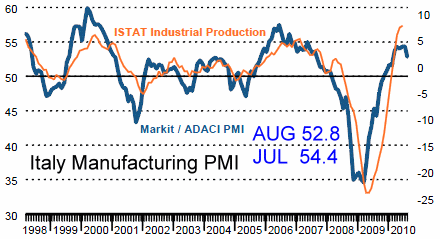
當 然﹐人們對全球製造業前景看法不一。據倫敦市場研究公司Markit Economics和英國皇家採購與供應學會(Chartered Institute of Purchasing and Supply)稱﹐8月英國的製造業增速大幅下滑﹐歐元區製造業增速減至6個月內最慢。歐元區製造業指數從7月的56.7降到8月的55.1。 Sara Murray / James R. Hagerty
不過 Murdoch對於新聞集團的前景感到樂觀,公司旗下產業如《福克斯電視網》(Fox TV networks)、《華爾街日報》和電影公司《二十世紀福克斯電影》(Twentieth Century Fox)等等,皆已度過了艱難的經濟挑戰,以及網路服務業者對傳統業務型態帶來的挑戰。 他強調公司的成功點,包括說服有線電視商,對其福克斯廣播節目支付轉播費用,以及劃時代的 3D電影《阿凡達》。
Murdoch表示,公司先前對於英國最大付費電視業者-英國天空廣播公司(BSkyB)進行全股收購,開價每股 700便士,可謂「具吸引力,且具邏輯性」的計畫。 在 Murdoch推動下,新聞集團單位不斷找尋新商業模式發展,如電子閱讀器或蘋果公司 (Apple Inc)(AAPL-US)的 iPad平板電腦等等。 新聞集團的福克斯和迪士尼 (The Walt Disney Co.)(DIS-US)的《ABC》,在其他主要電視台中脫穎而出,獲選和蘋果電視 (Apple TV)協商,提供新的 99美分租片服務。 Murdoch稱:「不創新的公司,將很難繼續生存。他們將被數字迷惑,迅速流失客戶來源。」
戴卓爾夫人是英國歷史上,至今唯一一位女性首相,並經選舉而產生的主要政黨女黨魁,且曾擔任四大國 家最高行政職務(the four great offices of state)的首位女性。希思曾在牛津大學修讀哲學、政治和經濟,鐵娘子原來也是他的校友,不過主修化學。當年,她更是牛津保守黨協會主席,政前成績與希 思不相伯仲。戴卓爾夫人擁有穩定家庭,誕下了一對孿生兄妹。她的富商丈夫於零三年逝世,兩夫婦婚姻長達五十二年。婚後,丈夫大力支持她修讀法律課程,並取 得大律師資格。或許,鐵娘子政壇戰績輝煌,也可能是擁有強勁後盾支持。希思被指是同性戀者,若然屬實,鐵娘子與他的關係便更微妙。鐵娘子是當年少有投票贊 成,把男同性戀行為合法化法案的保守黨議員。
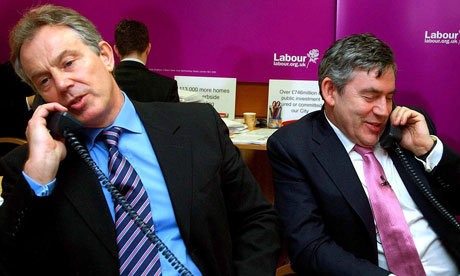
Tony Blair and Gordon Brown: Photograph: Rui Vieira/PATony Blair came to the view that Gordon Brown would be a disaster as prime minister and that Labour could not win the 2010 general election, he reveals in his long awaited memoirs.
"It was never going to work," Blair writes of Brown's three years in No 10, arguing that the former chancellor had "zero emotional intelligence" and fatally abandoned the New Labour formula.
Blair's memoir contains a passionate defence of the war in Iraq and of New Labour's public service and welfare reform plans, which the former prime minister believes his successor abandoned.
Although he refuses directly to endorse any candidate for the Labour leadership, he also makes a number of comments which are likely to be interpreted as criticism of Ed Miliband, vying with his brother David in a contest which reaches a climax as party members receive their ballot papers on Wednesday.
In the book and in his only pre-publication interview, Blair reveals that:
• Brown personally threatened to bring him down over the loans for honours scandal in 2006, before offering to stay his hand in return for the abandonment of Lord Turner's plans to reform pensions.
• He feels intense "anguish" over the lives lost in the Iraq war and failed to "guess the nightmare that unfolded".
• He believes Labour was wrong to ban fox hunting and pass the freedom of information act which is "not practical" for good government.
Blair nails his policy colours to the mast in his memoir by launching a sustained attack on the belief that the financial crisis means that voters want the return of the state as a major economic player. In remarks that will be seen as an implied attack on Ed Miliband and Ed Balls, Blair says voters will not elect a party which fails to offer a credible attack on the deficit.
In the interview, the former prime minister says "I adore the Labour party" – but warns Labour that if its attack on the Conservative-Lib Dem coalition "defaults to a 'Tory cutters and Lib Dem collaborators' mantra", then it will win some short-term popularity, but not be elected to government.
Speaking to the Guardian before he left for White House talks on the Middle East peace process, Blair said that his 700-page memoir showed New Labour would in time come to be seen as a "great reforming government" in which Brown played a very significant positive part. But his book reveals numerous occasions on which the struggle between the two New Labour titans sapped the strength and direction of the government, leading Blair to delay his handover to his chancellor.
"It is easy to say now, in the light of his tenture as prime minister, that I should have stopped it," Blair writes. But he would have been wrong to have sacked Brown as chancellor or to have campaigned against him becoming Labour leader. "At his best, his intellect and energy were vast and beneficial to the country," Blair writes.
However, Blair confirms in his interview with the Guardian that he believed Brown would be a "disaster" as prime minister unless he committed himself to the New Labour path laid out by his predecessor. "Labour won when it was New Labour," Blair writes in his memoir. "It lost because it stopped being New Labour."
The fresh focus on the long-running battle between Blair and Brown, which dates back to just after the 1992 election, Blair's account confirms, is likely to dismay many in the Labour party as the contest for the leadership gets underway. Yet Blair insists in his book and his Guardian interview that the argument is not about personalities but about policies.
On Iraq, Blair offers no change of heart but gives his most detailed defence yet of the policy of overthrowing Saddam Hussein in 2003. He writes emotionally of his anguish at not having anticipated "the nightmare that unfolded" after the initial success of toppling Saddam, and says he is devoting "a large part of the life left to me" to Middle East peace and interfaith reconciliation with the Muslim world.
He mounts a strong defence of the continuing war in Afghanistan and says that he would "not take a risk" of allowing Iran to acquire nuclear capability. However in his book Blair reveals that he "hesitated" before backing the renewal of Britain's Trident nuclear weapons in 2006.
Blair's outspoken remarks about the financial crisis and the aftermath of the British general election of 2010 in his book's postscript are likely to have a wide party political impact, especially his caution about any embrace of the view that "the state is back".
"The problem, I would say error, was in buying a package which combined deficit spending, heavy regulation, identifying banks as the malfeasants and jettisoning the reinvention of government in favour of the rehabilitation of government. The public understands the difference between the state being forced to intervene to stabilise the market and government back in fashion as a major actor in the economy."
Britain got what it wanted in May 2010, Blair claims – "a Tory version of a centrist government". A Labour-Lib Dem coalition was "never on" he argues. "2010 was one we were never going to win." Labour faces a danger of a drift to the left, Blair warns. If that is allowed to happen, it will lose even more conclusively in 2015. Source




 Source