2010/11/16

The British bayonet

Bagehot

The British bayonet

Do not underestimate the coalition’s pledge of a referendum on ceding new powers to the EU


IN POLITICS, it is the fate of the paranoid not to realise when they are winning. That is the moral of Westminster’s sulky reaction to a European Union Bill, due to be unveiled on November 11th. At its heart lies a European “referendum lock”: a pledge to hold a popular vote on any transfer of further powers from Britain to the European Union.

Conservative MPs who distrust the EU—ie, most of them—seem glumly certain that the referendum lock is a piffling idea, a gimmick that will do little to defend British interests. “Milk and water…a million miles away from what is required,” grumbles Bill Cash, a dogged (indeed relentless) Tory Eurosceptic who chairs the House of Commons European scrutiny committee. In contrast, pro-European members of the government (there are a few) present the referendum lock as a big and reassuring idea, capable of winning back the trust of a public enraged by years of treaty-making by stealth.

Actually, both camps are wrong. Britain’s new referendum lock is a big idea, whose consequences could take years to emerge. It will not make the British public love the EU: that is a lost cause. Instead, assuming that the EU decides it needs hefty new powers in the future (above and beyond current proposals about economic governance, which overwhelmingly concern countries using the single currency), the new lock would probably lead to a multi-speed EU with the British in the slow lane.

Would that be in Britain’s long-term national interests? It might be. The question merits serious debate. Alas, such debate is inaudible amid the din of general scepticism.
Any explanation must begin with an admission: Eurosceptic paranoia is not wholly irrational. Successive British governments have form when it comes to smuggling EU treaties past the public. The latest version of the EU rule book, the Lisbon treaty, is a sorry case in point. In a rash moment, Tony Blair promised Britons a referendum on its first version, the EU constitutional treaty. When French and Dutch voters voted down the constitution in 2005, Mr Blair gratefully scrapped his referendum and signed up to Plan B: chopping the constitution up and stuffing the bits into a new legal casing, like an unappetising Euro-sausage. That resulting creation, the Lisbon treaty, was specifically designed to avoid referendums in perilous places such as Britain. In the end only Ireland held a vote on Lisbon, and even that pro-European country had to vote twice before producing the answer Brussels wanted.
Tories have their own specific reasons to seethe. As opposition leader in 2007, David Cameron offered a “cast-iron guarantee” to hold a referendum on the Lisbon treaty. Two years later, after the treaty was ratified by all 27 EU members, Mr Cameron dropped his referendum pledge. Provoking some on his party’s right to fury, he explained that—regretfully—Lisbon was no longer a treaty but had become EU law, so his original promise was now moot. Mr Cameron pledged this would “never, ever” happen again: a future Conservative government would hand the British public a referendum lock to which “only they had the key”.

That lock was to be unveiled this week. There were two models for designing it, insiders say. The first—favoured by Whitehall’s silkiest mandarins—involved a “short, elegant formula” pledging a referendum on transfers of significant powers from Westminster to Brussels, with ministers deciding what “significant” meant. The second model involved scouring EU treaties for policy areas in which Britain has an opt-out or veto and methodically listing those which should be changed only by popular vote.

The lock follows this second path. It lists 56 policy areas where a referendum would be needed. A dozen of these come under so-called “ratchet clauses” in the EU rule book, which explicitly leave open the possibility of pooling further powers. Thus Britain would have to hold a referendum to adopt the single currency or to cede its vetoes over EU foreign policy, for instance. An act of Parliament would suffice for Britain to drop some more trifling vetoes, for example over the languages used inside EU institutions. Pledges on Europe need treating with caution, but if you wanted a real referendum lock, this is what it would look like.
This matters, because Britain is not like other EU members. Future British governments would have to be mad to call a referendum on an EU treaty. A straight in-out vote on EU membership could probably be won—just. But a vote on transferring new powers would be suicide: just ask Irish, French or Dutch politicians. A European Union Bill with a functioning referendum lock amounts to a UK Veto Bill. The consequences are stark: either Britain will have to be offered an opt-out from ambitious new treaties, or British voters will vote No and trigger a monumental row.

No, no, no
Why, then, are Eurosceptics so grumpy? Mainly because, like Talleyrand, they think bayonets are useful for everything except sitting on. They want Mr Cameron to use Britain’s vetoes now, not just talk about preserving them. Germany wants a new treaty setting out rules for euro-area governance? Let Britain hold such a new treaty hostage, they say, and demand the return of labour-regulation powers from Brussels: after all, new treaties must be ratified by all 27 members. What about the next EU budget, they add, or treaties admitting new countries?

Partly because he is in coalition with Liberal Democrats, but also because he is a pragmatic chap, Mr Cameron is playing a different game: looking for ways to give EU allies what they want (new euro-area rules for Germany, defence co-operation for France) while seeking support for his red lines, such as EU budget reform or, at the very least, budgetary thrift. If that leaves Britain on one edge of a multi-speed Europe, so be it. That is a big deal—unless, that is, you are too fixated on betrayal to see it.
SOURCE

英央行Weale: 未來幾月英國通脹或進一步上升

鉅亨網新聞中心 (來源:世華財訊) 2010-11-15 21:23:12
英央行理事Weale表示,未來幾個月英國通脹或進一步提升,央行可能因此將現行貨幣政策維持一段時間。

綜合媒體11月15日報導,英央行(Bank of England)貨幣政策委員會(Monetary Policy Committee)成員Martin Weale表示,不斷上升的英國通脹,以及隨后通脹預期上升,或足以使英央行將現行貨幣政策維持一段時間。

在討論英國潛在經濟增長之時,Weale表示,盡管各項情況可能將提振或打擊GDP,但當前較高水平的消費者物價指數,以及預期未來幾個月將持續上升正向其暗示,現在無需任何額外刺激舉措。

Weale在上周(11月8日當周)企業部門、創新及技術分析會議上表示,“未來幾個月通脹可能將顯著提升,即便預期隨后將下滑。”

Weale表示,“我確實擔憂在這種情況下,引入額外貨幣刺激政策對通脹預期造成的影響。”

Weale表示,不過,基於潛在閑置產能水平--英國產出缺口--在某些情況下,推出新一輪刺激舉措可能是正確之舉,“假設這種情況與履行通脹目標相一致。”

經濟學家表示,9月英國消費者物價指數(CPI)持穩於3.1%,預計當16日經調整數據公布后,將升至3.2%。

棉花、食品等未經處理的商品價格以及1月起英國銷售稅提高2.5個百分點均對英國CPI造成上行壓力。

英央行通脹目標為2%。

(武穎 編譯)

SOURCE

調查顯示:英國2011年上半年經濟可能放緩

鉅亨網新聞中心 (來源:世華財訊) 2010-11-15 15:35:20 
根據最新調查顯示,英國經濟可能將在2011年前兩個季度放緩,短期經濟增長前景仍然黯淡,但英國就業前景改善,盡管私營部門和公共部門間就業前景差距擴大。

綜合媒體11月15日報導,根據咨詢公司BDO LLP 11月15日公布的一項調查,英國經濟可能將在2011年前兩個季度放緩,但各企業已開始對英國經濟前景持更為樂觀態度。

BDO表示,BDO產出指數表明英國經濟最早可能在2010年12月萎縮,該指數預測了未來三個月的貿易情況。該指數10月跌破了95大關,至93.8,標志著自2009年6月以來的首次。

該咨詢公司表示,其樂觀指數仍然低於95水平線,表明“2011年第一季度經濟增幅可能為負值。”樂觀指數用於衡量英國企業對未來兩個季度的貿易情況預期。

BDO表示,2011年第二季度的經濟前景也較弱。

然而,10月的樂觀指數也確實較此前一月略有改善,該指數在4月至8月一直下跌。

BDO合伙人Peter Hemington 表示,“在近期內,經濟增長前景仍然黯淡。”“雖然2010年第二季度和第三季度的GDP數據高於預期,但這是由於建筑部門的短期刺激作用支撐,而該部門前景可能會疲軟,因受公共部門支出削減打擊。”

英國第三季度經濟季比擴大0.8%,超出了市場預期的0.4%。

該組織提議2011年第一季度前實施額外一輪的500億英鎊定量寬松政策,以“確保新一年的經濟增長不受損害。”

根據由英國特許人事和發展協會(The Chartered Institute of Personnel and Development, CIPD)和畢馬威(KPMG) 11月15日公布的季度就業市場前景調查,英國就業前景改善,計劃在2010年年底前招聘的雇主超過計劃裁員的雇主。

從不利方面來看,在政府10月宣布的削減開支計劃影響下,更多公共部門雇主目前正計劃裁員。

根據最新調查,計劃增加招聘的雇主凈比例為+11,高於上次調查的+2。

這一結果表明了計劃增加招聘的雇主與計劃裁員的雇主人數差額。

但是,私營部門和公共部門之間的鴻溝擴大。

計劃在今后一段時間增加招聘的私營企業雇主凈比例為+39,高於上次調查的+19。但計劃增加招聘的公共部門雇主凈比例為-44,這意味著更多計劃裁員的企業數量超過了增加招聘的企業。相比之下,此前的調查中該比例為-35。

(王媛媛 編譯)

SOURCE

英國經濟指標評估將納入“快樂指數”

2010年11月16日 06:48 來源: 深圳商報 

諾貝爾經濟學獎得主約瑟夫·斯蒂格利茨和阿馬蒂亞·森呼籲各國政府不要過度依賴國內生產總值(GDP)等純經濟指標評估和制定政策後,法國、加拿大等國政府開始往評估體系中引入更多反映民眾幸福程度的參數。

英國媒體14日報道,英國政府著手向法國、加拿大等國政府“取經”,首相戴維·卡梅倫定於本月晚些時候責令國家統計局設計一套新的統計方案,包括引入“快樂指數”,以幫助本國政府今後更合理地制定政策。

多方“取經”

諾貝爾經濟學獎得主斯蒂格利茨和森先前發佈一份報告,建議各國政府不要迷信國內生產總值等“硬性”指標,而應更加關注民眾的家庭財富、經濟發展方式是否可持續等“軟性”參數。

法國總統尼古拉·薩科齊去年宣布,有意往本國經濟增長評估體系中引入能夠反映民眾快樂程度和幸福狀況的參數。

加拿大統計部門在全國範圍調查中增設反映民眾幸福程度的項目,但尚未把調查結果納入官方統計數據。

英國《衛報》14日援引消息人士的話報道,英國政府著手與加拿大和法國政府對話,討論如何衡量民眾的幸福程度。

按照加拿大國家統計委員會委員約翰·赫利韋爾的說法,英國政府打算把斯蒂格利茨和森所發佈報告中“兩項最重要的因素落實為行動,那就是系統地衡量個人的幸福程度,以及利用這些數據為政策選項提供依據”。

“時代議題”

卡梅倫2005年12月出任保守黨領袖,5個月後宣佈,設法衡量民眾幸福程度是“我們這個時代的核心政治議題之一”。

卡梅倫今年6月出任首相,隨即出臺大幅削減財政開支措施,以避免英國像希臘那樣陷入主權債務危機。

不過,英國政府同時推進統計制度改革,過去兩個月來召集包括諾貝爾經濟學獎得主森在內的不少專家研究法國等國經驗。

“我們向其他國家學習,希望能更進一步,”一名消息人士告訴《衛報》記者,“一些人持懷疑態度。但戴維·卡梅倫清楚表明,他會這樣做;即使在困難時期,這仍會在議事日程之中。”

這名人士說:“國內生產總值的最終目的是,幫助人們過上更滿意的生活。無論是在經濟低迷時期還是繁榮時期,這一點的重要性沒什麼分別。”

英國政府定於本月25日要求獨立統計員吉爾·馬西森設計一套問題,最早于明年春季增補進現行居民調查問卷,內容包括衡量民眾的快樂程度、對人生目標的實現程度等。

定策依據

不同於法國和加拿大,英國所議改革更看重如何為今後制定政策提供參考和依據。

按照加拿大國家統計委員會委員赫利韋爾的說法,“加拿大統計員和研究員也在全國範圍調查個人的幸福程度,但這些數據迄今尚未吸引多少政策關注”。而在英國,“政府不僅打算在更廣範圍詳細採集涉及個人幸福程度的數據,而且要把這些數據擺在制定和評估政策的中心位置”。

英國首相府一名不願公開姓名的官員說:“如果我們大規模採集樣本,且每年採集不止一次,那麼人們便能對今後人生規劃作出恰當分析。我們下次全面評估支出方案時,無需猜測各項政策會對人們的幸福狀況產生何種影響,而是切實知道(存在何種影響)。”

具體實施方案尚待商議。例如,是編制一個“快樂指數”,還是編制多項指數綜合反映幸福程度等。(新華社供本報特稿)

(責任編輯:趙強)
SOURCE

歐英利率不變 立場差異再掀市場波瀾

010年11月05日 11:14 來源:每日經濟新聞 
週四(11月4日)晚間,英國央行和歐洲央行均宣佈維持基準利率不變,英鎊兌美元創近10個月新高,突破1.6200,歐元兌美元今年1月中旬以來首次突破1.42美元。

業內人士表示,歐洲央行與英國央行均維持基準利率不變,其與美聯儲的立場差異必然將大幅推升歐元和英鎊,短期內歐係貨幣將高位運行。

歐英央行維持利率不變

週四晚間8點,英國央行宣佈,維持利率在0.5%不變,維持2000億英鎊的資產購買規模不變。公佈利率決議後,英國央行沒有置評。

業內人士表示,英國央行維持現有貨幣政策不變,相對於美聯儲的6000億美元資產購買政策偏緊,利好英鎊走勢。

數據顯示,英國第二季度GDP意外強勁增長1.2%,且第三季度GDP初值環比增長0.8%,為市場預期的兩倍,反映英國經濟仍處於復蘇通道,冷卻了英國央行重啟量化寬鬆政策的趨勢,實行維持利率不變。

10月份英國製造業部門活動自3月份以來首次加速增長的數據更是支援了這一觀點。英國10月服務業採購經理人指數(PMI)為53.2,創6月來最高水準,也高於預期的52.5。與此同時,英國零售業協會(BRC)公佈的數據顯示,英國10月BRC商店物價指數月率上漲0.3%,年率上漲2.2%;9月該項指數月率上漲0.2%,年率上漲1.9%。

鋻於此前英國央行金恩表示,英國央行首次升息舉措很可能與英國央行的季度通脹報告公佈時間相一致,因此業界預計,英國央行首次升息時間可能在2011年5月或8月。

不過,英國經濟前景依舊面臨不確定因素,政府10月份宣佈的大規模減支措施很可能在2011年限制經濟增長。

一德研究院外匯研究員呂曉威對《每日經濟新聞》表示,英國近期的數據都偏好。“英國總體經濟的情況好于歐洲,同時英鎊也強于歐元。”

同日,歐洲央行宣佈維持1%的基準利率不變,隔夜貸款和存款利率在1.75%和0.25%不變。

歐洲央行行長特裏謝在講話中指出,歐元區潛在經濟復蘇動能仍然保持積極,但是經濟前景依然有不確定性。“儘管近期經濟數據向好,但對經濟的評估基本上沒有改變。經濟前景依然面臨小幅的下行風險。”

歐係貨幣高位運行

外匯市場上,英國央行維持基準利率和資產購買規模不變對英鎊形成支援,英鎊兌美元週四歐市盤中觸及1.6235的近10個月新高。

分析師指出,英鎊兌美元輕易突破1.6108的阻力位,短期目標指向1.6257。北京時間週四21:00,英鎊兌美元報1.6270。

同樣,因歐洲央行維持基準利率不變,北京時間週四21:00,歐元兌美元報1.4262的高點。

“一方面,美聯儲擴展貨幣刺激舉措,而歐洲央行和英國央行則將繼續承諾撤除危機時的刺激措施。”一銀行外匯分析師對 《每日經濟新聞》記者表示,短期內歐元和英鎊將繼續維持強勢。

“英鎊兌美元近期以來的升勢保持完好,匯價成功站穩1.60關口,預計短線英鎊或將繼續維持強勢。”

不過,也有分析師認為,歐元僅會溫和拉回。“隨著美國二次量化寬鬆舉措的實施,歐元也被間接推高,歐洲央行必須考慮歐元匯率的問題。”

分析師稱,歐元區和美國之間的利差,將在未來幾個月繼續推動歐元走勢,但歐元走強可能對歐元區經濟產生負面衝擊。

“可能導致歐元兌美元走勢大幅逆轉的唯一因素,就是歐美之間的利差再次接近,但這在短期內不大可能。”

實際上,英國央行和歐洲央行利率公佈利率決議前夕,國際匯市主要非美貨幣已震蕩走高。

北京時間週四16:17,英鎊兌美元突破1.6163美元,觸及9個月新高;北京時間週四16:32,歐元兌美元今年1月中旬以來首次突破1.42美元。

另據悉,為緩和日元近期持續升勢,日本央行將最快在週五召開緊急會議,討論額外的寬鬆貨幣措施。新的刺激經濟方案包括從目前財政預算內的儲備基金,提撥9200億日元 (約758億人民幣),推行包括促進就業和刺激內需的措施。

目前日元價位暫于80.35與81.95間整固,後市方面,外匯分析師預計日元短期仍受股市及交叉盤的表現所影響,暫于80.00~82.00之間波動。 (賀麒麟)
SOURCE

水瓶座的58個特点

1. 偏好低調,不愛出風頭,喜歡安靜。

2. 想借錢找水瓶成功的機率比較高,如果你和瓶子交情不錯,他們又有足够的錢借你。因爲瓶子不懂怎麽拒絕別人。借出去的錢還8好意思催別人還。 


3. 寬容。瓶子只會對別人寬容、却不會對自己寬容,對自己要求挺嚴格的。經常和自己過不去,別問理由,瓶子自己也不知道。


4. 水瓶不擅表達。如果你能感覺瓶子對你三分的喜愛,事實上會有五分;如果你能感覺到五分,事實上會有七分。水瓶是不坦白的,會淡化感情的表達,會壓抑自己的情緒。    


5. 審美觀超强愛一切美好的事物。比如帥哥美女,但只是欣賞,當作藝術品。  

   
6. 能忍,比如明明想見一個人,却不會見面。比如明明想知道誰的消息,却什麽都不問。除非不想忍。      


7. 不愛發短信,不愛打電話 懶蛋一個。對特別的人會例外。 
8. 自尊心很强!强過金錢,强過事業,也强過愛情。     

9. 水瓶需要慢慢相處,因爲瓶子是個被動的星座,慢熱的星座,放不開的星座,認識時間越久對你越好。如果只是你喜歡瓶子,瓶子却不喜歡,頻頻接觸的結果則是會對你越來越冷淡。  


10. 一見鍾情很難發生在水瓶身上,瓶子的愛需要時間。會喜歡很多人,却很難愛上一個人。喜歡細水長流的感情,暖暖細流,長長久久。 


11. 瓶子知道什麽是感恩圖報。你對他們仁,他們就對你義。   


12. 瓶子的喜歡不等于愛。多情而不濫情。   


13. 除了感性,水瓶也可以理性的可怕。會很現實的考慮兩個人的將來,如果覺得沒有未來,就放開。陰雲密布,吼吼吼~     


14.水瓶的情商其實挺低的,對這種事情有點遲鈍。  


15. 配合 瓶子喜歡配合別人,遷就別人。自我意識比較薄弱。


16. 其實水瓶不擅交際的,一般情况下不喜歡說太多。小老實,小保守。雖然嘴巴笨却知道什麽話該說,什麽話不該說。不過在人多的場合也不會扭扭捏捏小家子氣,說話會大大方方。這也是瓶子氣質出衆人緣好的一個原因。 


17. 水瓶重視內在多于外在,重視精神多于物質。   


18. 水瓶對朋友沒什麽要求人好就行,就算心直口快老得罪人也無所謂,因爲水瓶不愛生氣不會記仇對誰都會寬容,就算傷害過自己的人,只記得別人的好。  


19. 討厭誰不會表現出來,只是不愛和你說話,或者乾脆不睬你。   


20. 有了心愛的人後就會變得很沒安全感,怕寂寞。


21. 不要獻媚的亂誇獎,瓶子沒你想象的那麽虛榮,也沒你想象的那麽白痴。他們能清楚的分出哪句是虛情,哪句是假意。 


22. 水瓶的頭腦中性冷靜,不論男女分析對待問題不會因爲性別問題而偏激。處變不驚,水瓶做事情處理事情好像一直都會不緊不慢就算在一種很混亂的情况下也能冷靜的思考,不知道爲啥歸天性吧。 


23. 不喜歡做决定,小事情隨便怎麽樣都行,無所謂。大事情很喜歡聽朋友的意見,如果你是水瓶可以信賴的人他們會問你的意見,你需要做的只是分析,决定水瓶會自己來做。如果他們覺得你分析的有道理會在心裏琢磨,可行就采納如果水瓶有了自己的想法一旦下了决定就算全天下反對幾乎沒有改變的可能。一意孤行其實多多少少有些靠直覺行事,不過水瓶的直覺大多時候還蠻准的。  


24. 溫柔是水瓶的本性。就算外表看來是阿飛或者小太妹裏頭絕對有溫柔的一面。  


25. 水瓶喜歡和自己喜歡的人鬥鬥嘴。却不會大聲吵架或者說根本不會吵架。你想吵可以。水瓶只會轉頭走人。


26.瓶子有善辯的口才,被別人誤會的時候却不愛解釋。不要問爲什麽,就是不愛解釋。 


27. 不喜歡傷害任何人,寧願傷害自己。前景不樂觀時會對喜歡的人冷靜的說恨話,會口是心非。爲的是不傷害任何人,結果反到是既傷了別人,傷得更多却也正是瓶子自己。


28. 吃軟不吃硬的一族。你軟,瓶子就對你沒脾氣。你硬,瓶子就比你還橫。有項調查,十二星座謀殺記錄最少的就是善良的水瓶,不過發現大多死亡記錄裏都是和對方同歸于盡的。。。哈哈哈瓶子脾氣倔,惹怒了絕對敢和你同歸于盡。  


29. 讓水瓶消氣很容易,不管男瓶子還是女瓶子也不管對异性或者同性,只要你撒撒嬌說兩句軟話保准水瓶不會再有脾氣。   

30. 水瓶對朋友絕對够義氣,不過很多時候水瓶往往會低估自己這一點,只有碰到事情才能發現,偶原來有把錢借給朋友交學費搞到最後自己的學費沒錢交。 

31. 不管對朋友還是戀人在外邊水瓶絕對袒護的是你,就算錯的是你沒道理的是你也會和你一起對付外敵。不過事後你們單獨相處的時候才會告訴你說,他們覺得哪里哪里似乎是你的不妥。  


32. 不要因爲在瓶子面前丟了人而自卑或在意,因爲瓶子絕對不會在意。瓶子覺得有時候丟人也是可愛的一種表現。  


33. 不會打擊別人,開玩笑時候除外。  


34. 一般人都覺得水瓶會做人,不會得罪人。那是因爲水瓶覺得沒有和他們認真的必要。其實水瓶說話會很直,只有對好朋友說話才會一根腸子通到底,老說大實話。太直接偶爾會小傷人,但都是爲了朋友好。比如知道好朋友的男朋友和其他女生在一起,一定不會怕好朋友傷心而因此隱瞞,水瓶會直言不諱的幫好朋友看清事實,面對事實,减少以後的傷害。對此,瓶子當作身爲朋友義不容辭的責任。  

 
35. 水瓶不喜歡向別人提要求。對朋友一點要求都不會提。如果向你提要求,就代表對你的喜歡和信賴非同一般,不過就算再信賴一個人,水瓶也很少開口要求什麽。因爲水瓶是隨遇而安的,心態很平靜悠哉悠哉的吼吼~ 而且不喜歡欠任何人的人情。  


36. 不喜歡打探朋友的太多私事,因爲覺得不禮貌。也不喜歡逼喜歡的人的講不願講的,瓶子認爲這是一份尊重。 


37. 對于戀人的過去,過去就是過去,水瓶在乎的是現在的坦誠。同樣,瓶子不會把上一份感情留在現在生活裏,不允許心裏死去的人和眼前喜歡的人相提幷論,因爲會告訴自己,現在愛的才是最好的。同樣,水瓶死去的愛情,是絕對沒有可能愛火重燃的。 


38. 水瓶很好騙,因爲單純。瓶子不會沒事就想著別人是不是在騙自己。


39. 失戀的時候喜歡聽悲傷地情歌。既然傷就傷個够吧.   還會删除對方的電話號碼聯繫方式,以及丟掉有回憶的東西。


40. 水瓶對理財沒什麽概念。經常不知道自己帳戶裏有多少錢,也不知道花了多少錢。對父母挺捨得花錢。對好朋友和喜歡的人也不會把帳算的很清。  


41. 你可以欠水瓶的錢或者什麽,但是水瓶却不喜歡欠別人的。水瓶欠別人錢的時候會天天惦記著,老覺得不爽,比別人欠自己錢還不爽。理性的水瓶更感性,有顆不切實際單純美好的心靈。比如看到藍藍的天會感動,會覺得生活真美好。。。比如看到乞討的老人,會覺得可憐,然後想著以後有能力要幫助好多好多可憐的人- -0... 

42. 水瓶是脆弱的一族,却不會讓別人看到自己的weak,甚至最好的朋友。心裏有什麽憋悶,不喜歡找好朋友傾訴,有時候寧願拉著一個陌生人傾訴。因爲陌生人聽完就不會再記得那是誰的故事。瓶子會繼續撑起他們所謂的堅强的殼子。

43. 有條不紊的瓶子很少很難會情緒失控,也很少有人能讓水瓶情緒失控,如果有就是看的很重的事或人。失控時間不會很久,短些就是幾秒鐘,長些就是幾分鐘。然後很快又會恢復先前的平靜和冷靜。自我調節能力蠻强。


44. 心情低落或受傷的瓶子不需要任何人的安慰,更加不會自暴自弃一蹶不振,no way! 需要的只是空間時間以及那顆樂觀的心。會自我安慰,自己勸自己看開,自己爲自己療傷,自己把自己武裝。這個時候最好讓瓶子自己呆著,因爲朋友的出現不會對平子有什麽幫助,而且,瓶子更不希望朋友看到自己低落受傷的樣子。 


45. 水瓶是樂觀的,不喜歡對人抱怨,更不喜歡聽別人找自己訴苦。所以你最好別在瓶子面前抱怨,就算你是他們最好的朋友。當你抱怨第一句時瓶子會安慰你,抱怨第二句是會附和你,抱怨第三句的時候,保證水瓶已經失去了繼續聽下去的耐心,雖然不會表現出來,但你會發現瓶子已經開始不說話了,只是“恩恩恩”“是吖”“ 哦”。水瓶可以幫你出點子,做分析,但絕對受不了嘮嘮叨叨抱怨訴苦。  


46. 水瓶吃醋時不愛說話,也不會明講。只是你會發現瓶子有點氣嘟嘟的一個人生悶氣,說話語氣有點陰陽怪調,自然就8會給你好臉色看了。


47. 少說承諾,一旦說出就會履行;很少說“我愛你”,說了出來就是真的愛你。喜歡用行動來證明一切。責任心重。


48. 瓶子不愛懷疑別人,所以也別懷疑瓶子誠實度。懷疑的結果是讓瓶子傷心生氣,也會變得不再相信你。


49. 喜歡創造小驚喜,喜歡製作小浪漫。


50. 如果兩個互相相愛的人,水瓶覺得自己的存在阻礙對方的前途或發展,會選擇自動離開。很愛很愛你,所以願意,捨得讓你,往更多幸福的地方飛去.很愛很愛你,所以願意,不牽絆你,飛向幸福的地方去.在你身邊,是覺得你需要我。一旦覺得你不再需要我,也不再停留。


51. 甩掉水瓶很容易,只要給一個理由,就算是你編出來的。不管理由是真是假,但請你親口講出來,水瓶都會離開,因爲這是瓶子拿來替你說服瓶子自己的理由。瓶子不會糾纏,也不會乞求愛,更不會要施捨的愛。愛裏的瓶子异常要强。


52. 接受能力很强,什麽都可以理解,什麽都可以接受,但請你親口說出來。因爲即使瓶子猜得到,從別人那裏聽的到,也希望親耳聽你說出來。因爲關于你,瓶子在乎的只是你。  


53. 如果你不能給瓶子什麽,不要招惹他們,他們比你想象的單純,也沒你想象的堅强。 


54. 瓶子相信分手的戀人還可以做朋友,只要對方願意,希望大家都好。如果曾經那些叫,就不要帶著恨吧。 


55. 如果你表白後,一個瓶子對你說“不喜歡你”或者類似的話,就等于判了你死刑。這個時候不要想著繼續努力來感動瓶子。沒用的。瓶子就像彈簧,你施力越大,他們就把你彈的越遠。瓶子對自己不喜歡的人可以很殘忍,就算心裏會內疚也會繼續殘忍,好像這也是瓶子最冷血的時候。如果還想做朋友,就什麽都不要做。 


56. 被瓶子愛的人是幸福的,他們會爲你而活,請好好珍惜。 


57. 愛上瓶子的人是痛苦的,如果瓶子愛的不是你。結果往往是對瓶子又愛又恨又不願放弃。 

58. 小事糊塗,大事聰明。有些瓶子看起來是正常人,可經過交談後會發現有些很簡單的東西都不知道。不要以爲那是在裝,瓶子就是這樣,出人意料的單純,大家都懂的事情會不懂。發覺了單純之後也不要以爲瓶子就蠢的什麽都不懂,大事情照樣可以比你更有智慧,更有主見,更有見地。瓶子沒你想象的精明,他們本不是精打細算的人;瓶子沒你想象的愚蠢,他們有的是大智慧。
source

水瓶女

水瓶座女子的守護星是天王星。她所追隨的這顆星星是我們(多數人)一生都不曾見到的。在你有了這一個概念之後,以後看到水瓶座女子做一些你無法理解的事情的時候,你就應該不那麽意外了。
水瓶座的女子堅持追求自由。但這幷不表示她們的行爲大膽開放,拒絕接受傳統教條的束縛。她所追求的自由是精神上、思想上的。她可能今天研究心理學,過兩天 去學爵士舞,下個星期到醫院當義工。她好象可以屬于社會上任何一個族群,但又不是真正屬于那一個族群。她屬于她自己,似乎沒有任何人可以完全的占有她。

但她也從來不會霸道的想要占有別人。對于所有的事情,她似乎都有自己的標準,不受傳統的約束和影響。她很有“她的”原則,而且忠于原則。一如戀愛中的她,絕對忠于自己的情人一樣。

對許多瓶座女子來說,人生都是一場無盡的探索。各各階層的人,各種五花八門的事,都應該被瞭解、被關懷。因此;如果你有個瓶座的情人,你大可放心,她一定不會有太多時間粘著你。事實上,她或許還擔心你會無時無刻粘著她呢。

瓶座的女人幾乎都不是“金權主義者”,一個男人是否擁有財富、地位幷不是那麽重要。外表是否英俊瀟灑也不是她最重視的條件。她要尋找的是(在她心目中)有 智能、有胸襟,可以陪她一起追尋“人間道”的男人。喜歡吃醋,占有欲太强,太偏激,太保守的人,絕不是她心目中的理想伴侶。

你會發現她的朋友不少,而且,各種型都可能出現。因爲瓶座女子是擁有自己的道德法則,同時也尊重別人不同法則的。她喜歡跟各樣的朋友相處,而且也都能相處 融冾。但有時候她又會選擇作個獨行俠。遠離家人、朋友,甚至遠離你。請大方一點,給她一些自我的空間和時間,霸占她的軀殼沒有什麽好處。不要疑神疑鬼,在 她沒有和你分手之前,瓶座女子會保持她的忠實。而且她只相信自己對你的評價,別人的看法是無法動搖她的。不要寄望她會把一切的行踪、所有的想法,一字不漏 的向你報告。瓶座的女人不會喜歡說謊,但她堅持任何人都有“保留一點”的權利。當然,這樣的女子也不會要求你交出行程表和自白書的。水瓶座女子的“不多疑 ”,是她的另一項美德。

她的服裝穿著可能經常令你目瞪口呆。有時候高貴典雅,有時候性感動人,有時候俏皮可愛。不過,她的打扮通常是憑感覺,而不是看場合的。還有一項更了不起的本領,瓶座女子常會把所有你异想不到的東西組合在一起。

對于明理懂事的水瓶座女孩,你唯一可以抱怨的就是她不够熱情。她好象永遠都是凉凉的,從來沒有熱情如火的表現。關于這一點,外表的冷漠或許是表達方式的不 同。但是,她們的內心是溫暖而需要熱情的。”這樣的解釋,完全可以接受,相信你也應該能瞭解。更何况,她的淡然態度絲毫不影響她的美麗和女人味。水瓶座下 出現的美女非常多。

博愛開朗的水瓶座的女性同時也是非常合乎現代需要的妻子。她既不是大女人主義,也不是傳統宿命女子。她懂得在婚姻之中保留自我、尊重別人。或許她常會在你 們的談話中,冒出一句與主題完全無關的話。我相信你終究會習慣那只是她的邏輯推演方式和你不大一樣。久而久之你反而會期待這種與衆不同的樂趣。
source

水瓶女孩戀愛模式分析

在我的印象之中,水瓶座是個很透明的星座。這個12星座中唯一的革命家,强大的精神力,理性冷靜的思考模式,却沒有古怪難以理解的行爲特徵。這是個能讓你 很快接近的星座。他們有著超乎其他星座的樂觀和隨和。這種奇特而富有包容性的特點來自于他們對于世界美好的博愛和大同的渴望。

    分析水瓶座,必然變得很嚴肅。因爲這個星座背後所具有的特點,充滿了哲學,心理學的複雜意味,如果不能够拿出學術的嘴臉,你真的很難看透。作爲水瓶,他們 的情感方式獨特而充滿了理想主義。如果他們能够如其他關注精神世界的星座那樣,保持著一定感性和夢幻,那可能還好,可這個對心靈呼應,精神世界倍加關注的 星座,却在處理感情的時候表現出極其冷靜的特點來,這讓人們更加難以走入水瓶座的情感世界。不過對于本篇的主題-----水瓶女來說,女性的特有思想多少 中和了這種衝突,比起水瓶男,水瓶女更加能够調和好自身和星座之間的矛盾。

    對于水瓶女,大多數人都感到很隨和,很好接觸。是的,這個星座天生是一個善良和博愛的星座。他們幷不拒絕友好的接觸和交往。但是,請注意,這不代表他們就 很懂得社交。事實上,水瓶是極其不習慣于普通社交模式的。如果你仔細觀察,儘管隨和的水瓶却是很被動交際的。也就是說我不拒絕認識新的朋友,但是不代表我 會主動去找。這樣的想法占據了大部分水瓶座的內心。而作爲女生,水瓶女更加突出。你可能在很長時間裏,依然無法進入水瓶女的很重要的圈子裏,所以,追求水 瓶女的男人們會常常感到水瓶永遠跟你保持著某種良性的距離。

    因爲水瓶女生對于感情處理上過于理性,所以那些庸俗的“勾引策略”對她們來說,通常幷不奏效。除非你具備極大的吸引力。否則,你很難在最初就觀察出水瓶女 的心理。更別說,還有一種可能的情况是,水瓶女生根本沒有意識到你是對她有特殊意思的。因爲在水瓶女生的心裏,可能很多時候,她都是普通化了身邊的人們 了。這也讓她們錯失了很多美好的姻緣。
    怎麽樣,這樣不溫不火的性格,溫柔善良却又堅持主見的交際方法,有沒有嚇倒你?

    可是,我還要告訴你的是,當水瓶女生陷入愛情了可能就是另一番情景。因爲她們的感情不是一天形成的,所以表現出更加深厚的特徵。她們面對自己投入的感情, 絕對不亞于任何哀怨的星座,甚至更强。她們會患得患失,會在意你每個决定,會不安,會害怕你不在身旁。因爲對于她們來說,但凡能够占據心靈者,便已視爲精 神依靠。人無心不可活。如果水瓶女生認定了的愛情,面臨破裂的可能,那便是在精神世界剝奪了她的生命。

    不要覺得我誇張,這是很好理解的。一個人的感情就像投資,你付出的越多,寄托的越多,你必然越無法面對他消亡的現實。這就是人性。也是水瓶女生的命運。對于感情過于理性,反而難以自拔。

    水瓶女的關鍵字-----知己,隱忍
    對于這2個關鍵詞,我相信絕對是對于水瓶女獨一無二的評價。如果你能够參透這其中包含的東西,你對于水瓶女生的真實的認知就又上升了一個層面。

    其實,水瓶女這一生都在尋找一種叫做知己的人。這個無論是在她選擇戀愛對象,還是朋友的時候都是一樣的。不要被水瓶女隨和的交際手腕所迷惑,她們其實是把 大多數人都放在了同一個圈子裏,一個無法進入自己生活的圈子裏。所以,她們對于很多人很隨和,也很有包容力,因爲她們不在乎。這個認定,甚至在你接觸她的 第一刻就被認定。她對你的話顯得越不挑剔,就證明你距離她越遠。對于這個,她們完全是沒有意識的。也許每個水瓶女生的認定標準不同,但是苛刻程度和偏執程 度絕對讓其他人望塵莫及。這也就是爲什麽很多男人在水瓶女生的好友圈裏打轉,却始終無法突破的原因了。

    千萬不要覺得你怎麽樣,水瓶女就會喜歡你,這與你的長相無關,與你的學識無關,與你的“購買力”無關,她們有著他們自己的標準。 對于這個無法描述的知己,水瓶女生自己也許不會天天念叨那些標準,可是一旦遇到,她們就會馬上明白----那,就是她要找的人。不過,她們却又不敢馬上就 開展進攻,反而有意無意的拖慢這個過程。自我的認定,緩慢的接近過程,水瓶女生的愛情過程絕對是最難捕捉的一類了。

    所以,這些特徵下的水瓶女其實是極其能够隱忍的。這一點被大多數人所忽視,認爲這不是風向星座的特徵。也許吧,但是在水瓶女這裏却是非常明顯的特徵。因爲 只有這樣,她們才能繼續自己的目標。繼續自己固執的堅持。她們隱忍的東西真的很多,從不意的話語,到有意的欺騙。不想說,只是不想說。

    可是她們會崩潰,當然會崩潰。當一個人再也無法忍受自己背負的那些痛苦的時候,一定奎崩潰的。而最糟糕的是,水瓶偏偏是個重視精神的星座。一個人但凡損失 什麽,如果是物質層面的尚可彌補,可是如果是精神層面的,那恐怕不容易找到那麽合適的心藥。水瓶妹妹的崩潰,有著明顯爆發的臨界點。當她開始自哀自怨,開 始拒絕與人接觸,那就是傷心的開始。而作爲旁人的我們却無法安撫。因爲除了她自己,沒有人懂得,傷害她的是什麽。
    其實,我很想說,如果你不是水瓶女的知己型人物,你很難攻克水瓶女子的心。但是,我依然需要給你建議。因爲這總比讓她一個人寂寞的尋找下去來的好。

1 請保持你的真心沒有猥褻肮髒的小心眼。這個只喜歡觀察而不喜歡說的星座,可能會讓你大大低估她們對于你那些謊言的識別能力。如果你犯了錯,她們可能早就知道了。
2 你對于他人的態度,也會被水瓶女生觀察,幷且作爲認識你本質的手段。所以,小心!
3 不要心急,不要期待水瓶女生對你能够馬上火熱起來,這顯然不是這個星座會做的事情。
4 保證自己成爲他生命中最重要的朋友,相信我,那才是通往真愛的唯一道路,如果你還是他泛泛之交的某人,那麽你的道路還很遙遠。

關于愛情,寫了這麽多篇攻心策,你如果問我有沒有共通的成功秘籍。我告訴你,有。那就是,真心相對,堅持到底。這不是廢話。很多時候,這個時代給我們了許多浮躁,讓我們防備太深。其實,就算是受傷,也比沒有愛過好。不是麽?
source

2010/11/15

老師教太爛 英大學賠219萬

英國政府計畫調漲學費,學生要求也相對變多,去年一位研究生因投訴老師教學不力,獲得校方4萬5000英鎊(約台幣219萬元)的賠償。
英國每日郵報報導,審議學生申訴的獨立制裁辦公室(OIA)表示,學費上漲會增加學生對老師與大學的申訴,賠償金範圍在幾百英鎊至4萬5000英鎊不等。OIA說,去年有逾1000件的賠償申請,是2005年以來的雙倍。
OIA主任貝倫斯(Rob Behrens)說:「學費上漲申訴案件就變多,這很有可能發生,也是我們過去幾年看到的趨勢。學費上漲的影響之一就是學生變得好像消費者,會有更多要求。」
去年一名研究生獲校方4萬5000英鎊的賠償金,是目前金額最高的賠償。有些學生會自己找律師告大學,資料顯示,全英國的大學去年償還50名索賠成功的學生約6萬英鎊(約台幣292萬元)賠償金。
【2010/11/15 聯合報】
source

2010/11/12

Student protests: Manchester sit-in demands to see university accounts

Group from London demonstrations take action demanding University of Manchester reveal how cuts will affect their studies
University of Manchester
 
Protesting students staged a sit-in at the University of Manchester. Photograph: Don Mcphee for the Guardian
Students have occupied a building at the University of Manchester and are demanding access to the institution's accounts to find out how cuts are likely affect their studies.

About 40 students entered the John Owens building around 1.45pm. They say they are negotiating with the university authorities.

Jeremy Buck, 22, a student communications officer who is with the students and is speaking on their behalf, said: "The group has decided they want to look at the financial forecasts of the university to see how the cuts will impact on students, staff and departments ... after yesterday's demonstration people felt strongly that we want the momentum to continue."
A student demonstration in London yesterday attracted more than 50,000 people – more than double the number expected by organisers or police. It ended with 50 arrests after about 200 students occupied the Conservative party's headquarters at Millbank in central London. At one stage a protester threw a fire extinguisher off the roof of the seven-storey building. A police leader has said the culprit should be charged with attempted murder.
Buck said the students involved in today's protests had not been involved in the violence at Millbank. They had decided to take action on the coach back from yesterday's demonstration.

"The National Union of Students had first predicted there would be 10,000, then 20,000, and we actually got more than 50,000 people," he said. "It was an amazing experience to see so many students and staff from around the country coming together to oppose what is planned for education and the students here just wanted to do something to continue the momentum."

The students held a meeting at 1pm and 45 minutes later between 40 and 50 people had occupied the corridors of the John Owens building.

"It has been entirely peaceful and no damage has been caused," said Buck. "The university has offered to meet three people to discuss our requests but the students feel that they are a group and want to meet as a group. We are in discussions about this now."
Other students have been prevented from joining the protest and Buck said it was unclear how long the sit-in would last.

Three police vehicles were called to the university at 3.30pm. Among the small group of protesters outside was second-year biology student Robyn Forsythe. He said: "There was a meeting and it was decided that we would occupy the finance office. It is a peaceful demonstration and they are demanding freedom of movement within the university."

The protesters inside could be seen through a stained glass arched window on the first floor.
Joanna Gilmore, a law lecturer and branch rep for the University and College Union, speaking in a personal capacity, said the demonstration was vital to defend education. There had been cuts at the university with staff taking voluntary redundancy, she said.
source

Student protests planned on a national scale on 24 November

Proposals drawn up for national day of direct action as head of lecturers' union at Goldsmiths, London praises students' actions
Student demonstation against higher tuition fees
 
Students, one dressed as Edward Scissorhands, demonstate against higher tuition fees and cuts in university funding in Westminster on Wednesday. Photograph: Tony Kyriacou / Rex Features
 
Emboldened by the numbers who took to the streets of London to campaign against the proposal to charge up to £9,000 a year in fees, students are planning a wave of direct-action protests across the country.

Protesters occupied a building at the University of Manchester today, demanding access to accounts to see how government spending cuts may affect students and staff.
Grassroots groups were drawing up plans for a national day of action in two weeks' time. Michael Chessum, the co-founder of the National Campaign Against the Cuts, predicted there would be widespread disruption as students staged sit-ins, occupations or walkouts at universities and colleges on 24 November.

"We went off script: the script that said a few thousand people would turn up, complain a bit, and go home; and the cuts would go through pretty much as planned," said Chessum, 21, a sabbatical officer at University College London. "That has changed. Now students really feel they can stop this."

A statement published by student leaders praised the storming of the building housing Conservative party headquarters by a fringe group of protesters on Wednesday. "We reject any attempt to characterise the Millbank protest as small, 'extremist' or unrepresentative of our movement. We celebrate the fact that thousands of students were willing to send a message to the Tories that we will fight to win. Occupations are a long established tradition in the student movement that should be defended."

The statement was signed by Clare Solomon, president of the University of London Union, Cameron Tait, president of Sussex University's student union and Lee Hall, author of Billy Elliot, among others. It puts local student representatives at odds with the NUS national leadership, which condemned Wednesday's violence.

The Millbank protesters were also praised by the president of the lecturers' union at Goldsmiths, London, who said their actions had brought attention to the cause. John Wadsworth said: "Yesterday was a really good natured but equally angry demonstration against the damage that the coalition is doing to higher education.

"The real violence in this situation relates not to a smashed window but to the destructive impact of the cuts and privatisation that will follow if tuition fees are increased and if massive reductions in HE funding are implemented."

The NUS plans to campaign locally against Lib Dem MPs, reminding them of their pre-election pledge to vote against a rise in tuition fees that will apply in English universities. NUS president Aaron Porter said: "Its an issue of principle. Clegg talked about no more broken promises – they made a promise, and we will hold them to it." The union plans to raise petitions in constituencies with high numbers of student voters, warning MPs that they face losing their seat if they break their word on fees.

A number of Lib Dem MPs plan to vote against the proposal, due to be presented to parliament before Christmas. The 20 Lib Dem ministers, including Nick Clegg, the deputy prime minister, and the business secretary, Vince Cable, are expected to vote in favour. The resolution must be passed by both houses but cannot be amended. Clegg today admitted he should not have signed the NUS pledge on fees, blaming the state of public finances for the party's U-turn.

"I should have been more careful perhaps in signing that pledge," he said. "At the time I really thought we could do it. I just didn't know, of course, before we came into government, quite what the state of the finances were."

Writing in the Guardian today, Lib Dem MP Tim Farron describes fees as "the poll tax of our generation". He writes: "It is not for me to tell colleagues how to vote, but I believe that we need to move away from burdening young people with debt, towards a fairer system. Education should be available to all – not just those who can stomach the debt."
Lib Dem MP Lorely Burt said the party was "stuck between a rock and a hard place". She added: "This is not our policy. We are not comfortable with it. In the coalition agreement we didn't manage to get our own policy but we have modified the Browne report [on higher education funding] to inject a considerable amount of fairness and progressiveness into the programme."

Lib Dem opponents of a rise have not coalesced around an alternative policy. Martin Horwood, who plans either to abstain or vote against, said: "The long-term alternative is really to pay for student finance through income tax and probably an inevitable reduction in student numbers, neither popular options with our Conservative partners. So short term, I fear the alternative would be cuts in other areas like science or FE, which is why I'm hesitating to vote against."

Student protests today included a three-hour sit-in by 60 students at Manchester, demanding access to the university's accounts. "This is just what a few students who had the energy left after the London demo managed to achieve," said Jeremy Buck, 22.
In Cambridge, students protested at the university's annual science, engineering and technology careers fair against "the marketisation of education".
source

卡麥隆:G20要加把勁 解決貿易失衡問題


結束中國訪問行程後,英國首相卡麥隆11日抵達南韓首爾,出席20國集團(G20)高峰會,他在接受訪問時表示,20國集團會員國必須「多加把勁」,以達成解決全球經濟失衡的協議。

不過,卡麥隆強調化解「東方資金滿滿,西方債務充斥」之間鴻溝的必要性;同時也呼籲,要努力「遏止保護主義的抬頭」。

G20已開發國家及開發中國家會員國出席的這場高峰會,重心將放在貿易失衡及貨幣匯率的問題上。

SOURCE

卡梅倫訪華意在借中國經濟東風

11月9日至10日,英國首相戴維.卡梅倫開始了就任首相後的首次訪華行程。訪問期間,中國國家主席胡錦濤和國務院總理溫家寶分別與其會談。卡梅倫還與中國領導人一起了出席中英工商峰會。

關於這次訪問的宗旨,可以從卡梅倫的訪華團隊陣容中看出來。這是一支被媒體稱為“英國歷史上規模最大”的訪華團隊,成員包括財政、能源、教育和商業的4位內閣大臣和約50位工商界資深領袖。中英雙方將舉行財經對話、經貿聯委會、教育部長峰會和能源工作組會議等諸如經貿議題的會議。顯而易見,卡梅倫此次中國行是一次地地道道的經貿之旅。

這樣的訪華使命,是由英國目前的國內形勢決定的。就在11月2日,卡梅倫在倫敦與到訪的法國總統薩科齊簽署了兩國軍事合作協議。根據這個協議,英法兩國將組成“聯合遠征軍”,主要內容是共用航母、共同研發核技術、分享核機密等。雖然英法兩國關係不錯,但上述協議還是讓人感到愕然,因為關係親密的國家很多,但“共用軍隊”的還極為罕見。之所以做出這種很沒面子的安排,實在是經濟窘境使然。法國自不必說——近來因為養老金入不敷出,大罷工一浪接一浪,鬧得雞犬不寧,英國的情況是半斤八兩。由於經濟疲弱和主權債務過大,英國財政大臣奧斯本10月20日宣布,政府將施行二戰後最大規模的削減公共開支計劃,到2015年將削減大約830億英鎊的公共開支,包括王室花消在內的財撥款都將大幅削減,在未來五年將有近50萬個工作崗位被裁減。連王室那點花消都要算計,英國政府的經濟窘境可想而知。

面對如此局面,英國政府除了採取“節流”措施外,當然還要“開源”,也就是要增加賺錢門路。在此情況下,卡梅倫政府把目光轉向金融危機中仍保持經濟快速增長、且已躍居全球第二大經濟體的中國,實在是順理成章。就在卡梅倫訪華前夕,中國國家主席胡錦濤對法國進行了一次國事訪問,訪問期間,中法簽署了約200 億美元的經貿合作協議。這樣的業績,不可能不讓英國人眼熱。11月4日,英國駐華大使吳思田在京對媒體表示,希望卡梅倫的此次中國之行能和中國簽訂一些商業大單。可以肯定的是,卡梅倫帶來的是一支商業團隊,帶走的將是一筆筆商業大單。

其實,中英確實也有強化經貿合作的政治基礎和潛力。近年來,雖然中德關係、中法關係一度出現挫折,並因此導致中歐關係短暫停滯——2008年的中歐峰會還因此被延期,但中英關係卻保持了平穩發展的勢頭。這或許與英國外交一向謹慎持重,對外政策很少出現大起大落的起伏有關。當然,這並不是中英之間就沒有一點過節。去年10月,中國依法處死了英籍毒犯阿克毛,當時的布郎政府就對此一再說三道四,引起了中方的相當不滿;哥本哈根氣候峰會結束後,布郎政府又把峰會未取得實質進展的責任,歸結到中國頭上。中英關係也因為上述事件,受到了一定影響。

不過,自今年5月卡梅倫首相上台後,中英關係呈現出良好的發展勢頭。中方對此也予以了充分肯定。11月2日,外交部發言人洪磊在新聞發布會上表示,“英國新政府上台執政以來,中英高層接觸頻繁,各領域合作進展順利,兩國關係有了一個良好開局。”

當然,卡梅倫此次訪華除了經貿合作這個重頭戲外,也就全球性問題同中方交換了看法。中英外交官也都通過不同的方式證實了這一點。10月19日,中國駐英大使劉曉明在倫敦皇家學會發表演講時表示,“今天的中英關係,早已超出了雙邊範疇,具有全球性和戰略性……雙方應當在國際事務中攜手合作,同舟共濟,共同致力於促進世界和平、穩定和繁榮。” 

英國駐華大使吳思田也表示,卡梅倫此行不僅要推動雙邊貿易合作,還希望和中國在全球治理、防止核擴散、可持續發展等多個領域進行對話和合作。中方還特別強調卡梅倫訪華“正值G20峰會前夕”,也暗示雙方將就這一議題進行會談。

今年以來,中英關係的發展勢頭良好,高層互動頻繁。今年1月,楊潔篪外長在倫敦與英國外交大臣米利班德舉行了會談,雙方強調要確保兩國關係沿著正確的軌道發展;3月,英國外交大臣米利班德訪華,溫家寶總理會見,雙方同意提升中英戰略對話級別。中英關係的一大優勢在於,雙方沒有明顯的戰略和利益衝突。卡梅倫首相的這次訪華使中英關係“百尺竿頭,更進一步”。
SOURCE

貨幣戰系列之三:在首爾協商停戰?

G20峰會召開前,貨幣戰陰雲籠罩,不少人擔心首爾這兩天將變成中美就匯率交鋒的場所,以及新興經濟體對美國和中國的貨幣政策表達不滿的場所。

新興國家和一些有貿易順差的發達國家已經對弱勢美元的衝擊發起「抵抗」。

峰會召開前,巴西和泰國已經利用稅務措施控制遊資湧入的規模;日本、韓國和其他一些國家直接購入美元拋出本幣以遏制本幣升值。

有觀點認為既然這些國家經濟表現比西方好,那麼它們就得設法接受現實。

停戰談判?

那麼,首爾的會議桌是否會成為貨幣戰的停戰談判桌?

英國杜倫大學金融學教授張志超認為,G20會議桌會成為談判桌,但不會是停戰談判桌。世界經濟再平衡是個漫長的過程,而且現在諸多跡象都表明各方都認為協商解決爭端比貨幣對抗好。

美國財長蓋特納不久前提出,應該給經常賬戶設定指標以平衡盈餘和赤字,但遭到中國、德國、日本的反對。

英國央行行長在峰會前夕也表示反對以量化指標和政策手段來管理經常賬戶,理由是這樣做會導致越來越多的國家通過政策手段管理貿易盈虧,而這對所有人都有害無利。

世界經濟失衡正是貨幣戰的深層次根源。

經濟「再平衡」

一個普遍認同的觀點是,中國的崛起對世界一些國家和行業造成「間接傷害」是事實,即使沒有匯率問題,這個矛盾也難以消除。

中國崛起有兩大特點造成了它成為貿易戰、貨幣戰或領導權爭奪戰的中心:崛起速度快和國內地區差異大、層次多。

第一個特點意味著中國競爭對手調整產業結構的時間較短,第二個特點意味著中國從沿海向內陸逐級以推,在國際價值鏈上都能找到大致對應的競爭對手。

而將注意力從外匯管理轉向經常賬戶管理是解決問題的一個新趨勢

中信證券首席宏觀經濟師胡一帆預計,G20會議將不會產生任何具體措施,但各國領導人會對一些重要問題在戰略層面上達成共識,諸如「貨幣戰爭無贏家」、「全球合作以防止經濟二次探底「等等。

重新平衡國際平衡是G20峰會最為重要的議題。儘管在減少不平衡問題的必要性上達成共識,不同國家都會從自己利益的角度出發,考量解決不平衡問題的迫切性。

管理經常賬戶就是一個新的思路。

經常賬戶

張志超認為,中國在多邊會談中應該不會迴避順差問題,但可能會有條件,比如要求這種談判在世界經濟再平衡的討論框架內進行,並以此交換美國在人民幣匯率問題上不再施壓。

他認為近期而言中國能同意的是使中美貿易不再擴大;長期而言,如果要對中美貿易順差設定數量指標,那麼談判的焦點將可能是時間限度。

國際經濟失衡反映在順差國儲蓄高、赤字國儲蓄低,以及不同國家政府舉債程度的不同。

在赤字國,金融危機後政府債務增加,部分衝抵私人儲蓄下降造成的空缺。

如果中國和其他順差國能增加進口,對赤字國減少逆差將大有幫助。

張志超認為,貨幣戰的威脅真正解除,一個重要標誌是國際貨幣基金組織內部的權力架構調整,新興經濟體的發言權比現在更接近經濟現實,在貨幣、匯率和貿易等規則的制方面能扮演更大的角色。
SOURCE

2010/11/11

Students protest against fees hike


      An estimated 50,000 students attend central London rally, during which windows were smashed at Tory HQ


    Student fees protest - photos from the route

    As the students on the Demo 2010 march snake their way along the Thames, we bring you the latest pictures


    Student fees protest: 'This is just the beginning'

    • Tory HQ attacked as demonstration spirals out of control
    • 35 arrested and 14 injured in violent clashes at Millbank
    • Police admit being caught out by scale of student action
     

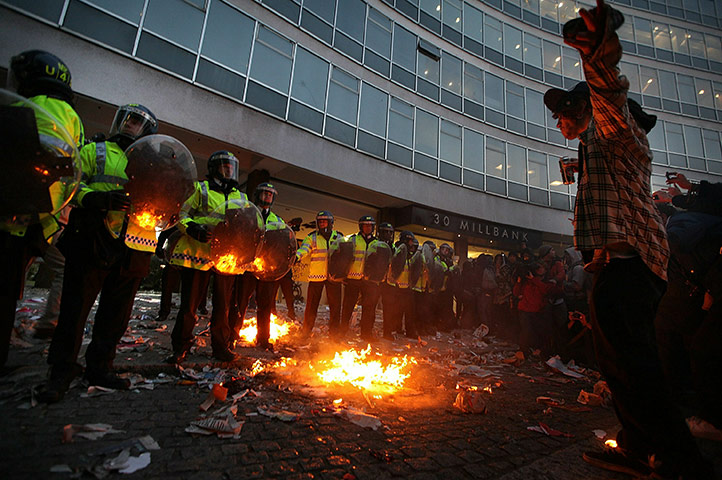
    A wing of the protest turned violent as around 200 people stormed 30 Millbank, the central London building that is home to Tory HQ Link to this video
      Tens of thousands of students took to the streets of London today in a demonstration that spiralled out of control when a fringe group of protesters hurled missiles at police and occupied the building housing Conservative party headquarters.

    Tonight both ministers and protesters acknowledged that the demonstration – by far the largest and most dramatic yet in response to the government's austerity measures – was "just the beginning" of public anger over cuts. Police, meanwhile, were criticised for failing to anticipate the scale of the disorder.

    An estimated 52,000 people, according to the National Union of Students, marched through central London to display their anger over government plans to increase tuition fees while cutting state funding for university teaching. A wing of the protest turned violent as around 200 people stormed 30 Millbank, the central London building that is home to Tory HQ, where police wielding batons clashed with a crowd hurling placard sticks, eggs and some bottles. Demonstrators shattered windows and waved anarchist flags from the roof of the building, while masked activists traded punches with police to chants of "Tory scum".

    Police conceded that they had failed to anticipate the level of violence from protesters who trashed the lobby of the Millbank building. Missiles including a fire extinguisher were thrown from the roof and clashes saw 14 people – a mix of officers and protesters – taken to hospital and 35 arrests. Sir Paul Stephenson, Met police commissioner, said the force should have anticipated the level ofviolence better. He said: "It's not acceptable. It's an embarrassment for London and for us."

    While Tory headquarters suffered the brunt of the violence, Liberal Democrat headquarters in nearby Cowley Street were not targeted. "This is not what we pay the Met commissioner to do," one senior Conservative told the Guardian. "It looks like they put heavy security around Lib Dem HQ but completely forgot about our party HQ."

    Lady Warsi, the Tory party chair, was in her office when protesters broke in. She initially had no police protection as the protesters made their way up the fire stairs to the roof. Police who eventually made it to Tory HQ decided not to evacuate staff from the building but to concentrate on removing the demonstrators.

    The NUS president, Aaron Porter, condemned the actions of "a minority of idiots" but hailed the turnout as the biggest student demonstration in generations. The largely good-natured protest was organised by the NUS and the lecturers' union the UCU, who have attacked coalition plans to raise tuition fees as high as £9,000 while making 40% cuts to university teaching budgets. The higher fees will be introduced for undergraduates starting in 2012, if the proposals are sanctioned by the Commons in a vote due before Christmas. The NUS president told protesters: "We're in the fight of our lives. We face an unprecedented attack on our future before it has even begun. They're proposing barbaric cuts that would brutalise our colleges and universities."

    Inside parliament the deputy prime minister, Nick Clegg – the focus of much anger among protesters for his now abandoned pledge to scrap all tuition fees – came under sustained attack, facing 10 questions on tuition fees during his stand-in performance during prime minister's questions. He said there was consensus across the parties about the need to reform the system.

    Labour's deputy leader, Harriet Harman, said the rise in fees was not part of the effort to tackle the deficit but about Clegg "going along with Tory plans to shove the cost of higher education on to students and their families". She said: "We all know what it's like: you are at freshers' week, you meet up with a dodgy bloke and you do things that you regret. Isn't it true he has been led astray by the Tories, isn't that the truth of it?"

    Meanwhile one student won an unexpected concession from the coalition yesterday. In answer to a question from a Chinese student during his trip to China, David Cameron said: "Raising tuition fees will do two things. It will make sure our universities are well funded and we won't go on increasing so fast the fees for overseas students … We have done the difficult thing. We have put up contributions for British students. Yes, foreign students will still pay a significant amount of money, but we should now be able to keep that growth under control."

    Additional reporting by Rachel Williams and Matthew Taylor

    Police caught out by peaceful student protest that turned violent

    Student leaders condemn violence as protesters smash windows and scale roof of Tory party headquarters
    Student protesters wave from the roof of 30 Millbank,  home of Conservative Party headquaters
     
    Student protesters wave from the roof of 30 Millbank, home of Conservative Party headquaters. Photograph: Peter Macdiarmid/Getty Images
     
    The defiant text message from student protesters who had reached the roof of the Conservative party's headquarters was sent at 3.04pm.

    "We stand against the cuts, in solidarity with all the poor, elderly, disabled and working people affected," read the message, quickly circulated among a thousand rioting students in the forecourt below, who had run out of windows to smash and gathered around smouldering fires.

    "We are against all cuts and the marketisation of education. We are occupying the roof of Tory HQ to show we are against the Tory system of attacking the poor and helping the rich. This is only the beginning."

    If that proves to be true, the coalition government will be bracing itself for the type of violent unrest that has not been seen in the UK for decades.

    The chaotic scenes in the lobby of 30 Millbank this afternoon, where brawling protesters overpowered thin lines of police, was unprecedented for a student protest, and considerably worse than the damage to an RBS building by activists at last year's G20 demonstration.
    Office workers were evacuated from the building as windows were shattered with rocks and sticks and CCTV cameras were ripped from the ceiling. Parts of the building were ransacked; protesters used furniture for fuel on bonfires outside. For about an hour the violent rampage bore all the hallmarks of a riot.

    The Metropolitan police, who had been briefing reporters on the eve of the march to expect "nothing out of the ordinary" from the demonstration, had clearly been overwhelmed. The scale of the demonstration became apparent hours earlier, when tens of thousands gathered near Trafalgar Square at midday for a march intended to take them along the Embankment, past Westminster to Millbank, where they were told to gather for speeches.

    The Met had been told to expect 15,000 protesters, and briefed journalists the night before that the National Union of Students, which co-organised the march with the University and College Union, may have inflated their numbers.

    At it turned out, the figures were an underestimate. Hundreds of coaches had been booked to draft protesters in from across the country and packed crowds stretched the length of Whitehall, with just 225 police officers lining the pavement to deal with any unrest.

    The march was seemingly good-natured as it snaked past the House of Commons to benign chants of, "No ifs, no buts, no education cuts". Repeated attempts at "sit-downs" to block the roads around Parliament Square lasted only a few minutes. Protesters became angry at one of their own when a green smoke canister hurled toward police struck a tourist instead.
    Police may not have known it, but word had quickly spread through the crowd that the Tory headquarters would be the target of an "action". Around 1.15pm a breakaway group of 200 or so activists stormed the Millbank building complex by the Thames, which contains the Tory party's HQ and a few government agencies. The NUS condemned the violence, saying it had not been planned.

    Whoever did orchestrate the violent occupation, it did not go to plan, as activists initially entered Millbank Tower – the wrong building. Minimal security meant that minutes later they left easily and sprinted across the road to the building that houses the Tory party and barricaded themselves inside.

    About 1,000 activists congregated in a courtyard outside, starting fires with burning placards and shouting chants of "Tory scum". Eggs, sticks and bottles were thrown at a thin line of police blocking the entrance, and officers were unable to prevent repeated crowd surges.
    They were overpowered at least six times. On each occasion dozens of protesters forced their way in. At least 14 people were taken to hospital with minor injuries, police said. Several police suffered head wounds.

    Once inside, protesters took the lift to the third floor, got on to the roof and used chairs to smash windows from the inside. "We were in the courtyard [of Millbank] and people were smashing through the glass to get into the building and saying 'Come in', so we just went into the building," said Olivia Wedderburn, 18, from east London.

    "Then there was an opportunity to go up the stairs so we thought 'Oh we'll do that', so we went up there. There were only about 20 or 30 people going up the stairs, but on the way up the whole staircase was flooded – they had pulled down a fire hose and flooded all the floors. All the windows were getting smashed, everything was getting smashed up all around."

    She added: "They were mainly young students, [with] just a couple of older guys who looked like old-school anarchists." As night fell and territorial support group "snatch squads" began hauling activists out, large segments of the crowd turned against the occupiers of the building.

    Many expressed dismay at the violence and when a fire extinguisher was hurled at police from the roof, chants condemning the coalition were replaced with an even louder chorus from the crowd below of "stop throwing shit".

    NUS president, Aaron Porter, tweeted: "Disgusted that the actions of a minority of idiots are trying to undermine 50,000 who came to make a peaceful protest."

    Summarising the sentiment of those who began walking away from the Millbank, which was strewn with broken glass and graffiti, Scott Sygrove, 18, from Bournemouth, said: "Protest is absolutely fine, but breaking windows is over the top. "We're all pissed off – pardon my French – but they are causing a lot of damage and frustration. This will only make things worse. Violence is not the answer to a peaceful protest."

    From 6pm, the remaining groups of protesters in the courtyard were corralled in so-called "kettles" and arrested in small numbers. A chunk of the crowd moved to Parliament Square, where students carrying duvets said they planned to set up an "education camp".

    Sebilio Uribe, 24, said: "We want to show that this a peaceful, proactive way to bring our message to the government and show we can organise and mobilise. "We aim to stay here for as long as possible until this government listens to the 50,000 students who have marched today."

    A small group who remained in the ransacked lobby of Conservative HQ showed similar determination. One young woman did her make-up just feet from a uniformed riot officer. Another held up a sign reading: "We are hostages to the police. We are fine but want pizza, lower uni fees."
    source

    At the student protests, the ancient cry of 'Tory scum' once again echoed out

    It is a cosy cliche of demonstrations that the 'unrepresentative minority' spoil a good-tempered protest. Today this was true
    Students and teachers gather in central London to protest against university funding cuts.
     
    Students and teachers gather in central London to protest against university funding cuts and Government plans to charge up to £9,000 per year in fees from 2012. Photograph: Steve Parsons/PA
     
     
    Right on cue, exactly six months into David Cameron's premiership, the ancient British roar of "Tory scum" echoed across central London again. In honour of the coalition's deal on higher tuition fees, student protesters spliced their message with cheerful abuse of Nick Clegg. After almost 100 years of apathy Lib Dems can hold their heads high – hated at last.
    It is a cosy cliche of demonstrations that get out of hand that the kind of "unrepresentative minority" which attacked the Millbank Tower and its squat neighbour, 30 Millbank, had spoiled an otherwise good-tempered protest. Today this was true.
    Nobody riots in the rain, so the weather must share some blame. As hundreds of student buses converged on central London the sun shone provocatively from a blue sky. Streams of students poured into the Strand, the LSE contingent louder, as usual, than those from nearby UCL. "Banks don't cure disease", declared one gentle placard; "Science is more useful than duck islands" and "Ancient Norse is not a luxury," said others.
    The aggressive note struck by the inevitable Socialist Workers party's "F**k the Fees" poster was a hint of things to come, although the SWP asterisks hinted at tactical restraint in a way that the chant "Nick Clegg/We Know You/You're A Fucking Tory Too" did not.
    Shoppers, bemused tourists and non-graduate building workers in hard hats showed little hostility. David, a graphic designer from Devon, who has been "paying more than my fair share of tax" since graduating in 1966, was disdainful: "There is no such thing as free education. It is paid for by our taxes."
    In Trafalgar Square an irate bus driver confessed: "I was sympathetic until they blocked my bus. Where are the police?" Good question. Parliament itself, key Whitehall ministries and Lib Dem HQ in Cowley Street were well protected, but this was a decidedly under-policed demo – until it was too late.
    The first and more violent Grosvenor Square demo against the Vietnam war in 1968 attracted a reported 60,000, the poll tax riots of 1990 three times as many, the Chartist demo in 1848 even more. Yesterday's estimates ranged from 30,000 to 50,000, angry but polite. Diane Wheeler, a sixth-form teacher from Milton Keynes, carried a banner on behalf of her students. "Mrs Wheeler says No to higher tuition fees", it read.
    The students of 2010 seem much better dressed than the soixante-huitards. Old ideological certainties have also faded, but the crowd reflected the multicultural face of modern Britain. There were brand new Oxbridge scarves ("only six of us from St Anne's: I'm afraid everyone's too busy working"), six busloads from Canterbury's assorted campuses and four teenagers from Manchester sporting neat hijabs and a "Don't Crush My Dreams" poster.
    Creative arts students seemed especially fearful that their courses might be axed. Public school students ("my father's a diplomat, so I can afford the extra fees") declared solidarity with talented but poorer colleagues who might be squeezed out. "Cut fees – or we'll cut off your balls", declared the poster held by a young woman in pink trainers.
    The idea was that, after lobbying MPs – Cheltenham's Martin Horwood was the only Lib Dem MP to risk venturing outside – the throng would arrive outside Tate Britain for stirring speeches from the NUS leadership, many of whom will be MPs too in due course.
    But the unrepresentive minority had heard that the Millbank complex (in an earlier building the birthplace of Tony Benn) housed the Tory party HQ. Bare-chested, masked and armed with staves, they set about smashing windows. Why? "Tory HQ, property of the capitalist state, mate," explained one. Anarchists, street gangs, Trots or undercover police provocateurs – plenty of theories about the assailants' identity bounced around the crowd.
    Few took part, but many cheered. Inevitably they broke into both buildings. Eggs were thrown along with looted flowers. "Some twats have just decided to spoil it for the rest of us," cried Dan Hamilton, a mature student from Leicester. Only when the vanguard had reached the roof and started throwing things ("that's a fire extinguisher, completely out of order") did the Met's tactical support group appear in sufficient numbers to get a grip.
    Outside the Tate a female police officer nursed a badly bleeding head, a colleague a sharp blow to her face. Seven protesters were hurt too.
    Leaving their banners outside, some opted to duck out of the ruck and into the Tate's tranquillity for soup of the day (£3.85) and this month's special exhibition: the 18th-century Romantics – another group of frustrated young people breaking free of their elders. It seemed appropriate.
    source

    PwC:英國舉債上癮 5年後政府負債恐達161兆美元

    鉅亨網編譯張正芊 綜合外電  2010-11-10 19:15:40
    國際會計師事務所普華永道 (PwC,PricewaterhouseCoopers) 周二 (9 日) 發布報告預估,英國政府總負債水準,至 2015 年恐大增 33%,達 10 兆英鎊 (161 兆美元),對英國長期經濟成長構成威脅。

    PwC 在報告中指出,未來 5 年英國消費者、企業、銀行業及政府都將增加負債。屆時財政負債相當於國內生產毛額 (GDP) 的比例,將由目前的 67% 大增至 77%;而英國民眾總負債金額,將達到 GDP 的 5.4 倍。

    過去 10 年來,房產相關貸款及金融同業間的放款,已讓英國家庭及企業負債激增。此外,受到經濟衰退衝擊,英國政府稅收減少,同時仍需大行開支,以紓困金融業並刺激經濟,造成公共負債也大增。

    PwC 首席經濟學家 John Hawksworth 在聲明中警告:「英國對於債務上癮,已到達令人擔憂的水準」。他表示,這個問題遲早都得解決;或是透過巨幅刪減負債,但這恐怕會刺激另一場經濟衰退;或是比較可能背負一再加重的借貸成本度日,而這恐將影響未來數十年的經濟成長幅度。

    PwC 並認為,英國政府計畫實行的大規模財政緊縮措施,可能會影響經濟成長,且雖然「應可讓利率更長一段時間維持在低點」,但最終貸款成本仍必須反彈。

    Hawksworth 指出,目前格外低的利率水準,無法永遠維持;「大部分 (英國) 家庭及企業的貸款,仍暴露於房產及商業地產價格進一步下跌的風險之下」。 

    source

    英美兩國領袖「哈亞洲」 歐巴馬與卡麥隆的東遊記

    • 英國首相卡麥隆與美國總統歐巴馬,並肩朝亞洲新興大國找尋合作機會。(圖/美聯社)


    (2010/11/10 13:46)

    記者鮑蓉蓉/綜合報導

    南韓首爾G20高峰會尚未開幕,英美兩國領導人不約而同的順道造訪亞洲各大國。歐巴馬造訪印度、印尼、日本,而英國首相卡麥隆則是選擇了中國大 陸,不外乎就是為了建立貿易夥伴並強化經濟合作關係。英美兩國領袖的「哈亞洲」東遊記,再度凸顯了金融風暴之後的重心轉移,以及蓬勃發展中的亞洲經濟體不 容小覷的發展前景。

    歐巴馬印度行短短3天,就替美國簽下100億美元合約、間接製造5300萬個工作機會;面對印度送上的大禮,歐巴馬也以「支持印度爭取聯合國常任 理事」為回禮。歐巴馬隨後造訪童年故鄉印尼,即使停留不到24個小時,但面對這個全球最大的穆斯林國家,歐巴馬還是很有效率地與印尼總統舉行雙邊對談,簽 訂「全面夥伴關係協定」(Comprehensive Partnership Agreement),以促進兩國經貿與保安合作。

    有別於歐巴馬的選擇,英國首相卡麥隆則前往中國大陸,作為高峰會前的停靠站。短短兩天行程,卡麥隆卻帶上了英國史上規模最大的代表團一塊參訪,包括4位內閣部長以及逾50位企業界領袖加入這次的中國大陸行,展現英國新政府對此行的重視。

    中英兩國的貿易關係相當不平衡,出口差異高達三倍,舉例來說,單單英國對愛爾蘭的出口,就遠大於對中國、印度、巴西、俄羅斯這「金磚四國」的總和。對於中國大陸13億人口的這塊市場大餅,歐美各國無不覬覦。

    卡麥隆此行盼望中英兩國的貿易額可以在未來5年內翻倍,使每年達到1000億美元;短短兩天的行程,雙方預計將簽訂四十多條商議協定,以此改善中英的經貿關係。

    由於這是在劉曉波獲諾貝爾和平獎後,首度有西方領袖造訪,外界好奇卡麥隆是否會在與中國大陸國務院總理溫家寶會面時提及敏感的人權問題。雖然面對 輿論壓力,但卡麥隆仍以經貿合作為重點,在提及「中英兩國對人權以及政治自由有不同的見解」後,卡麥隆接著表示,不會因此對中國大陸「說教或威嚇」,並強 調這番談話也不代表「英國在道德方面高人一等」。

    歐巴馬與卡麥隆開了東遊記的先端,再次凸顯亞洲經濟體發展實力不容小覷;中國大陸和印度這兩大國,均將逐漸轉型成為消費國,這樣的轉變將帶來就業機會以及市場商機,而當全球面臨大量熱錢亂竄以及歐洲的債務危機之際,亞洲的新興市場,也將成為投資者的新落腳處。source

    英財相:英港合作人幣交易

    英國財相歐思邦(圈圖)昨日在本港談中國商機,稱香港和倫敦作為國際金融中心,雙方應屬夥伴而非競爭對手。

    G20達共識樂觀
    歐思邦認為,由於倫敦與香港在語言、文化及制度上接近,在發展人民幣國際化的事務上,彼此可以合作共享商機。倫敦將消除人民幣交易的一些限制,有條件成為人民幣在西方的交易中心。

    被問到人民幣升值的問題,歐思邦則表示,全球貿易失衡不只是貨幣匯率問題,當中涉及更廣泛的因素。對於今日在首爾舉行的G20峰會,歐思邦對各國在國際銀行體系流動性標準等議題上達成共識,表示樂觀。儘管在第二輪量化寬鬆措施(QE2)上,美國備受各國批評,但作為美國傳統盟友的英國,始終表示支持。歐思邦稱,美國經濟的強勁復甦,對亞洲及全球均屬有利,同時對於美國現時經濟及房屋市場不應該過於悲觀,預期美國經濟將會出現反彈。
    source

    英國政府徵1000名中文老師 年收入百萬以上

    路透社報導,英國政府宣布,未來五年將在英國培訓1000名中文教師,提供學生學中文的機會。報導說,這項決定,是希望能進一步加強英國與中國的商務貿易關係。

    報導指出,目前,在英國只有大約一百名中文老師,政府希望五年之內,再培訓出1000人。

    不少英國學生和家長都認為,中文是最有用的外語,取代了以往的法文或德文。

    英國政府今天宣布,為了強化與中國的商業關係,未來5年將在英國訓練1000名新的中文老師。

    目前全英國已經有100名左右的合格中文老師,這1000名新增的中文老師將是一股生力軍。

    這項計畫目的在於每個11歲以上的學童,如果想要學中文,都有足夠的老師教導。

    中國已經成為全球第2大經濟強國,使得英國家長和學生把中文當作最有用的學習語言,而不是傳統的法語和德語。

    這項政策宣布的同時,英國首相卡麥隆(DavidCameron)正率領龐大經貿團訪問中國。

    目前英國學習中文的需求快速增加,合格教師卻供不應求。

    這些新老師將接受幾所英國大學的短期課程,並且在北京大學接受夏季特訓。
    source

    英國央行: 通貨膨脹率2012年年初或跌至2.0%目標水平下方

    鉅亨網新聞中心 (來源:世華財訊) 2010-11-10 20:00:16

    英央行表示,通貨膨脹率2012年年初或跌至目標水平下方;英央行保留了擴大量化寬松政策的可能性。

    綜合媒體11月10日報導, 英國央行(Bank of England)貨幣政策委員會(Monetary Policy Committee,MPC)周三(11月10日)暗示,無需立即采取新一輪的刺激措施,但保留實施刺激政策的可能性;英央行預計通貨膨脹率2012年年初將降至2.0%的目標水平下方。

    在其季度通貨膨脹報告中,MPC表示,經濟復甦將會繼續下去,而英國政府的支出審查幾乎沒有就經濟前景進行新的評估;在支出審查報告中,英國政府詳細公布了其支出削減計劃,打算在未來5年削減開支1,130億英鎊。

    但英央行表示,經濟復甦弱於預期的風險依然很高,因此,英央行保留了使用最新央行貨幣來擴大其量化寬松政策的可能性;英央行一直將其債券購買規模維持在2,000億英鎊不變。

    美聯儲(U.S. Federal Reserve)上周就新一輪的量化寬松政策進行投票,決定在6月底之前購買6,000億美元的長期國債,但英央行選擇維持其政策立場不變,因英國經濟最近數月的增長速度快於預期。

    根據量化寬松政策維持不變、利率在2011年年末上調25個基點并在2012年進一步上調50個基點的假設前提,MPC預計英國的通貨膨脹率在2012年年初會降至2.0%的目標水平下方,并且在2013年年末之前依然會位於2.0%的下方。

    但是,英央行預計近期的通貨膨脹率可能略高於其先前預期,部分歸因於英鎊對進口價格造成的影響。
    source

    英國重申嚴格限制非歐盟國家移民引爭論

    2010年11月7日 10:04
    來源:中國廣播網 選稿:張侃理

    東方網11月7日消息:據中國之聲《新聞縱橫》報道,在英國的華人朋友聚會時,現在談得最多的,恐怕就是英國一個叫做"移民上限"的政策。英國內政大臣特麗薩·梅近日在其上任以來發表的首次有關移民政策的講話中表示,必須採取嚴厲措施限制移民涌入英國,使非歐盟國家的外來移民數量減少到可以容忍的水準。不過,這一政策目前卻在英國上下引起了不小的爭論。詳細情況,我們馬上連線中國之聲國際新聞編輯王宗英:

    主持人:我們想知道英國移民上限政策的內容是什麼,實行這樣的限制政策以後英國的移民政策會發生怎樣的變化?

    編輯:原來在歐盟的各個成員國當中,英國的移民政策是最寬鬆的,從1997年的工黨政府執政以來,英國政府對外來移民一直採取著敞開大門的態度,但是在給英國經濟做出貢獻的同時,移民還是對英國的住房、醫院、教育和交通等公共服務帶來了嚴峻的挑戰,具體表現在首先是住房嚴重緊缺,從 1997年到2009年,英國凈流入移民數量220萬人,其中光是去年一年凈流入移民就達到了19萬6千人。英國新聯合政府上臺後承諾,到2015年之前把這個數字減少一半。為了實現這個目標,英國政府就設定了技術移民的上限,今年6月提出的臨時上限目標是每年發放24100個技術移民簽證,固定上限數量將會在明年四月份提出來。另外,為了限制不符合要求的移民涌入,英國政府還準備推出一個新的英語考試計劃,能夠感覺到實行這樣一個移民上限以後,移民數量從每年19萬下降到2萬多,降幅非常大,移民英國也將會困難得多。

    主持人:剛才你也提到了,作為英國這樣一個移民比較多的國家,它這次出臺嚴厲移民政策原因,我們很想知道這樣一些政策出臺之後對於英國經濟的發展會有怎樣的影響,還有英國的民眾是否認同這樣一個新的移民封頂政策呢?

    編輯:實際上從24100臨時上限在今年6月實施以來已經遭到了英國銀行和跨國企業的強烈抨擊。另外在英國政府內部也傳出了以商業大臣為首的反對的聲音,他提出警告說移民上限將會損害企業雇人的能力,他的反對意見得到了保守黨幾個部長的支援。對此英國首相卡梅倫宣佈將推出一個新的創業簽證,鼓勵有好的生意頭腦和雄厚財力的海外企業家到英國創業。此前卡梅倫也已經表示,跨國公司的僱員不受政府移民上限的限制,也就是說跨國公司僱員內部轉調到英國的話不受移民上限的限制。不過這個人才戰略還是遭到了質疑,一份報告就顯示,在抽樣調查1184名海外移民當中,只有1/4的人在真正從事高技術工作,29%的人都是從事低技術的工作,比如店員、超市收銀員、保安和呼叫中心的工作人員等等,其中有些人已經在英國工作了將近一年,但是他們必須擁有 25000英鎊的年薪才能繼續延簽。另外還有46%的高技術移民資料不詳,不知道他們現在的工作情況,而且英國移民大臣也表示,海外移民從事低技術職業使得英國這類就業市場飽和,這些工作崗位原本是屬於廣大的英國人民的,通過高技術移民途徑來到英國的人,應該做適合他們本職的工作,而不應該成為進入低技術就業市場的方式,他說相關部門還會對此進行討論,重新制定每年高技術移民的人選和人數的上限。但是有技術移民就認為,英國社會對外來技術人員的接納度很低,有技術難找工作的現象在技術移民的群體當中也是十分的普遍。
    source
    Related Posts Plugin for WordPress, Blogger...