Protesting students staged a sit-in at the University of Manchester. Photograph: Don Mcphee for the GuardianStudents have occupied a building at the University of Manchester and are demanding access to the institution's accounts to find out how cuts are likely affect their studies.
About 40 students entered the John Owens building around 1.45pm. They say they are negotiating with the university authorities.
Jeremy Buck, 22, a student communications officer who is with the students and is speaking on their behalf, said: "The group has decided they want to look at the financial forecasts of the university to see how the cuts will impact on students, staff and departments ... after yesterday's demonstration people felt strongly that we want the momentum to continue." A student demonstration in London yesterday attracted more than 50,000 people – more than double the number expected by organisers or police. It ended with 50 arrests after about 200 students occupied the Conservative party's headquarters at Millbank in central London. At one stage a protester threw a fire extinguisher off the roof of the seven-storey building. A police leader has said the culprit should be charged with attempted murder.
Buck said the students involved in today's protests had not been involved in the violence at Millbank. They had decided to take action on the coach back from yesterday's demonstration.
"The National Union of Students had first predicted there would be 10,000, then 20,000, and we actually got more than 50,000 people," he said. "It was an amazing experience to see so many students and staff from around the country coming together to oppose what is planned for education and the students here just wanted to do something to continue the momentum."
The students held a meeting at 1pm and 45 minutes later between 40 and 50 people had occupied the corridors of the John Owens building.
"It has been entirely peaceful and no damage has been caused," said Buck. "The university has offered to meet three people to discuss our requests but the students feel that they are a group and want to meet as a group. We are in discussions about this now."
Other students have been prevented from joining the protest and Buck said it was unclear how long the sit-in would last.
Three police vehicles were called to the university at 3.30pm. Among the small group of protesters outside was second-year biology student Robyn Forsythe. He said: "There was a meeting and it was decided that we would occupy the finance office. It is a peaceful demonstration and they are demanding freedom of movement within the university."
The protesters inside could be seen through a stained glass arched window on the first floor.
Joanna Gilmore, a law lecturer and branch rep for the University and College Union, speaking in a personal capacity, said the demonstration was vital to defend education. There had been cuts at the university with staff taking voluntary redundancy, she said. source
Students, one dressed as Edward Scissorhands, demonstate against higher tuition fees and cuts in university funding in Westminster on Wednesday. Photograph: Tony Kyriacou / Rex Features
Emboldened by the numbers who took to the streets of London to campaign against the proposal to charge up to £9,000 a year in fees, students are planning a wave of direct-action protests across the country.
Protesters occupied a building at the University of Manchester today, demanding access to accounts to see how government spending cuts may affect students and staff.
Grassroots groups were drawing up plans for a national day of action in two weeks' time. Michael Chessum, the co-founder of the National Campaign Against the Cuts, predicted there would be widespread disruption as students staged sit-ins, occupations or walkouts at universities and colleges on 24 November.
"We went off script: the script that said a few thousand people would turn up, complain a bit, and go home; and the cuts would go through pretty much as planned," said Chessum, 21, a sabbatical officer at University College London. "That has changed. Now students really feel they can stop this."
A statement published by student leaders praised the storming of the building housing Conservative party headquarters by a fringe group of protesters on Wednesday. "We reject any attempt to characterise the Millbank protest as small, 'extremist' or unrepresentative of our movement. We celebrate the fact that thousands of students were willing to send a message to the Tories that we will fight to win. Occupations are a long established tradition in the student movement that should be defended."
The statement was signed by Clare Solomon, president of the University of London Union, Cameron Tait, president of Sussex University's student union and Lee Hall, author of Billy Elliot, among others. It puts local student representatives at odds with the NUS national leadership, which condemned Wednesday's violence.
The Millbank protesters were also praised by the president of the lecturers' union at Goldsmiths, London, who said their actions had brought attention to the cause. John Wadsworth said: "Yesterday was a really good natured but equally angry demonstration against the damage that the coalition is doing to higher education.
"The real violence in this situation relates not to a smashed window but to the destructive impact of the cuts and privatisation that will follow if tuition fees are increased and if massive reductions in HE funding are implemented."
The NUS plans to campaign locally against Lib Dem MPs, reminding them of their pre-election pledge to vote against a rise in tuition fees that will apply in English universities. NUS president Aaron Porter said: "Its an issue of principle. Clegg talked about no more broken promises – they made a promise, and we will hold them to it." The union plans to raise petitions in constituencies with high numbers of student voters, warning MPs that they face losing their seat if they break their word on fees.
A number of Lib Dem MPs plan to vote against the proposal, due to be presented to parliament before Christmas. The 20 Lib Dem ministers, including Nick Clegg, the deputy prime minister, and the business secretary, Vince Cable, are expected to vote in favour. The resolution must be passed by both houses but cannot be amended. Clegg today admitted he should not have signed the NUS pledge on fees, blaming the state of public finances for the party's U-turn.
"I should have been more careful perhaps in signing that pledge," he said. "At the time I really thought we could do it. I just didn't know, of course, before we came into government, quite what the state of the finances were."
Writing in the Guardian today, Lib Dem MP Tim Farron describes fees as "the poll tax of our generation". He writes: "It is not for me to tell colleagues how to vote, but I believe that we need to move away from burdening young people with debt, towards a fairer system. Education should be available to all – not just those who can stomach the debt."
Lib Dem MP Lorely Burt said the party was "stuck between a rock and a hard place". She added: "This is not our policy. We are not comfortable with it. In the coalition agreement we didn't manage to get our own policy but we have modified the Browne report [on higher education funding] to inject a considerable amount of fairness and progressiveness into the programme."
Lib Dem opponents of a rise have not coalesced around an alternative policy. Martin Horwood, who plans either to abstain or vote against, said: "The long-term alternative is really to pay for student finance through income tax and probably an inevitable reduction in student numbers, neither popular options with our Conservative partners. So short term, I fear the alternative would be cuts in other areas like science or FE, which is why I'm hesitating to vote against."
Student protests today included a three-hour sit-in by 60 students at Manchester, demanding access to the university's accounts. "This is just what a few students who had the energy left after the London demo managed to achieve," said Jeremy Buck, 22.
In Cambridge, students protested at the university's annual science, engineering and technology careers fair against "the marketisation of education". source
• Tory HQ attacked as demonstration spirals out of control
• 35 arrested and 14 injured in violent clashes at Millbank
• Police admit being caught out by scale of student action
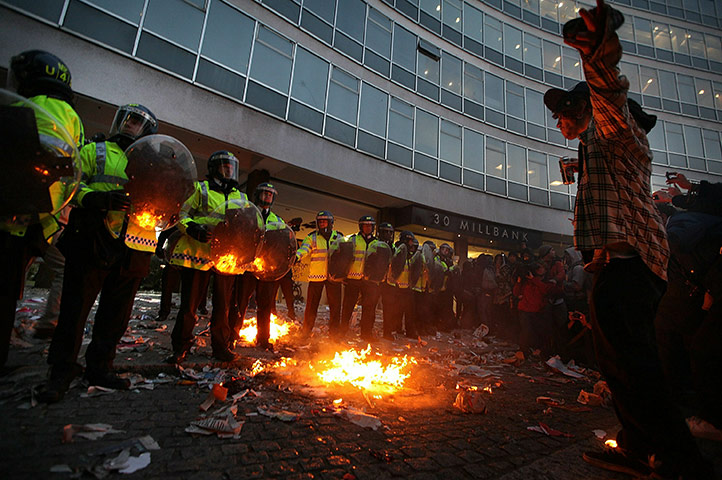
A wing of the protest turned violent as around 200 people stormed 30 Millbank, the central London building that is home to Tory HQ Link to this video
Tens of thousands of students took to the streets of London today in a demonstration that spiralled out of control when a fringe group of protesters hurled missiles at police and occupied the building housing Conservative party headquarters.
Tonight both ministers and protesters acknowledged that the demonstration – by far the largest and most dramatic yet in response to the government's austerity measures – was "just the beginning" of public anger over cuts. Police, meanwhile, were criticised for failing to anticipate the scale of the disorder.
An estimated 52,000 people, according to the National Union of Students, marched through central London to display their anger over government plans to increase tuition fees while cutting state funding for university teaching. A wing of the protest turned violent as around 200 people stormed 30 Millbank, the central London building that is home to Tory HQ, where police wielding batons clashed with a crowd hurling placard sticks, eggs and some bottles. Demonstrators shattered windows and waved anarchist flags from the roof of the building, while masked activists traded punches with police to chants of "Tory scum".
Police conceded that they had failed to anticipate the level of violence from protesters who trashed the lobby of the Millbank building. Missiles including a fire extinguisher were thrown from the roof and clashes saw 14 people – a mix of officers and protesters – taken to hospital and 35 arrests. Sir Paul Stephenson, Met police commissioner, said the force should have anticipated the level ofviolence better. He said: "It's not acceptable. It's an embarrassment for London and for us."
While Tory headquarters suffered the brunt of the violence, Liberal Democrat headquarters in nearby Cowley Street were not targeted. "This is not what we pay the Met commissioner to do," one senior Conservative told the Guardian. "It looks like they put heavy security around Lib Dem HQ but completely forgot about our party HQ."
Lady Warsi, the Tory party chair, was in her office when protesters broke in. She initially had no police protection as the protesters made their way up the fire stairs to the roof. Police who eventually made it to Tory HQ decided not to evacuate staff from the building but to concentrate on removing the demonstrators.
The NUS president, Aaron Porter, condemned the actions of "a minority of idiots" but hailed the turnout as the biggest student demonstration in generations. The largely good-natured protest was organised by the NUS and the lecturers' union the UCU, who have attacked coalition plans to raise tuition fees as high as £9,000 while making 40% cuts to university teaching budgets. The higher fees will be introduced for undergraduates starting in 2012, if the proposals are sanctioned by the Commons in a vote due before Christmas. The NUS president told protesters: "We're in the fight of our lives. We face an unprecedented attack on our future before it has even begun. They're proposing barbaric cuts that would brutalise our colleges and universities."
Inside parliament the deputy prime minister, Nick Clegg – the focus of much anger among protesters for his now abandoned pledge to scrap all tuition fees – came under sustained attack, facing 10 questions on tuition fees during his stand-in performance during prime minister's questions. He said there was consensus across the parties about the need to reform the system.
Labour's deputy leader, Harriet Harman, said the rise in fees was not part of the effort to tackle the deficit but about Clegg "going along with Tory plans to shove the cost of higher education on to students and their families". She said: "We all know what it's like: you are at freshers' week, you meet up with a dodgy bloke and you do things that you regret. Isn't it true he has been led astray by the Tories, isn't that the truth of it?"
Meanwhile one student won an unexpected concession from the coalition yesterday. In answer to a question from a Chinese student during his trip to China, David Cameron said: "Raising tuition fees will do two things. It will make sure our universities are well funded and we won't go on increasing so fast the fees for overseas students … We have done the difficult thing. We have put up contributions for British students. Yes, foreign students will still pay a significant amount of money, but we should now be able to keep that growth under control."
Additional reporting by Rachel Williams and Matthew Taylor
Student protesters wave from the roof of 30 Millbank, home of Conservative Party headquaters. Photograph: Peter Macdiarmid/Getty Images
The defiant text message from student protesters who had reached the roof of the Conservative party's headquarters was sent at 3.04pm.
"We stand against the cuts, in solidarity with all the poor, elderly, disabled and working people affected," read the message, quickly circulated among a thousand rioting students in the forecourt below, who had run out of windows to smash and gathered around smouldering fires.
"We are against all cuts and the marketisation of education. We are occupying the roof of Tory HQ to show we are against the Tory system of attacking the poor and helping the rich. This is only the beginning."
If that proves to be true, the coalition government will be bracing itself for the type of violent unrest that has not been seen in the UK for decades.
The chaotic scenes in the lobby of 30 Millbank this afternoon, where brawling protesters overpowered thin lines of police, was unprecedented for a student protest, and considerably worse than the damage to an RBS building by activists at last year's G20 demonstration. Office workers were evacuated from the building as windows were shattered with rocks and sticks and CCTV cameras were ripped from the ceiling. Parts of the building were ransacked; protesters used furniture for fuel on bonfires outside. For about an hour the violent rampage bore all the hallmarks of a riot.
The Metropolitan police, who had been briefing reporters on the eve of the march to expect "nothing out of the ordinary" from the demonstration, had clearly been overwhelmed. The scale of the demonstration became apparent hours earlier, when tens of thousands gathered near Trafalgar Square at midday for a march intended to take them along the Embankment, past Westminster to Millbank, where they were told to gather for speeches.
The Met had been told to expect 15,000 protesters, and briefed journalists the night before that the National Union of Students, which co-organised the march with the University and College Union, may have inflated their numbers.
At it turned out, the figures were an underestimate. Hundreds of coaches had been booked to draft protesters in from across the country and packed crowds stretched the length of Whitehall, with just 225 police officers lining the pavement to deal with any unrest.
The march was seemingly good-natured as it snaked past the House of Commons to benign chants of, "No ifs, no buts, no education cuts". Repeated attempts at "sit-downs" to block the roads around Parliament Square lasted only a few minutes. Protesters became angry at one of their own when a green smoke canister hurled toward police struck a tourist instead. Police may not have known it, but word had quickly spread through the crowd that the Tory headquarters would be the target of an "action". Around 1.15pm a breakaway group of 200 or so activists stormed the Millbank building complex by the Thames, which contains the Tory party's HQ and a few government agencies. The NUS condemned the violence, saying it had not been planned.
Whoever did orchestrate the violent occupation, it did not go to plan, as activists initially entered Millbank Tower – the wrong building. Minimal security meant that minutes later they left easily and sprinted across the road to the building that houses the Tory party and barricaded themselves inside.
About 1,000 activists congregated in a courtyard outside, starting fires with burning placards and shouting chants of "Tory scum". Eggs, sticks and bottles were thrown at a thin line of police blocking the entrance, and officers were unable to prevent repeated crowd surges. They were overpowered at least six times. On each occasion dozens of protesters forced their way in. At least 14 people were taken to hospital with minor injuries, police said. Several police suffered head wounds.
Once inside, protesters took the lift to the third floor, got on to the roof and used chairs to smash windows from the inside. "We were in the courtyard [of Millbank] and people were smashing through the glass to get into the building and saying 'Come in', so we just went into the building," said Olivia Wedderburn, 18, from east London.
"Then there was an opportunity to go up the stairs so we thought 'Oh we'll do that', so we went up there. There were only about 20 or 30 people going up the stairs, but on the way up the whole staircase was flooded – they had pulled down a fire hose and flooded all the floors. All the windows were getting smashed, everything was getting smashed up all around."
She added: "They were mainly young students, [with] just a couple of older guys who looked like old-school anarchists." As night fell and territorial support group "snatch squads" began hauling activists out, large segments of the crowd turned against the occupiers of the building.
Many expressed dismay at the violence and when a fire extinguisher was hurled at police from the roof, chants condemning the coalition were replaced with an even louder chorus from the crowd below of "stop throwing shit".
NUS president, Aaron Porter, tweeted: "Disgusted that the actions of a minority of idiots are trying to undermine 50,000 who came to make a peaceful protest."
Summarising the sentiment of those who began walking away from the Millbank, which was strewn with broken glass and graffiti, Scott Sygrove, 18, from Bournemouth, said: "Protest is absolutely fine, but breaking windows is over the top. "We're all pissed off – pardon my French – but they are causing a lot of damage and frustration. This will only make things worse. Violence is not the answer to a peaceful protest."
From 6pm, the remaining groups of protesters in the courtyard were corralled in so-called "kettles" and arrested in small numbers. A chunk of the crowd moved to Parliament Square, where students carrying duvets said they planned to set up an "education camp".
Sebilio Uribe, 24, said: "We want to show that this a peaceful, proactive way to bring our message to the government and show we can organise and mobilise. "We aim to stay here for as long as possible until this government listens to the 50,000 students who have marched today."
A small group who remained in the ransacked lobby of Conservative HQ showed similar determination. One young woman did her make-up just feet from a uniformed riot officer. Another held up a sign reading: "We are hostages to the police. We are fine but want pizza, lower uni fees." source
Students and teachers gather in central London to protest against university funding cuts and Government plans to charge up to £9,000 per year in fees from 2012. Photograph: Steve Parsons/PA
Right on cue, exactly six months into David Cameron's premiership, the ancient British roar of "Tory scum" echoed across central London again. In honour of the coalition's deal on higher tuition fees, student protesters spliced their message with cheerful abuse of Nick Clegg. After almost 100 years of apathy Lib Dems can hold their heads high – hated at last. It is a cosy cliche of demonstrations that get out of hand that the kind of "unrepresentative minority" which attacked the Millbank Tower and its squat neighbour, 30 Millbank, had spoiled an otherwise good-tempered protest. Today this was true. Nobody riots in the rain, so the weather must share some blame. As hundreds of student buses converged on central London the sun shone provocatively from a blue sky. Streams of students poured into the Strand, the LSE contingent louder, as usual, than those from nearby UCL. "Banks don't cure disease", declared one gentle placard; "Science is more useful than duck islands" and "Ancient Norse is not a luxury," said others. The aggressive note struck by the inevitable Socialist Workers party's "F**k the Fees" poster was a hint of things to come, although the SWP asterisks hinted at tactical restraint in a way that the chant "Nick Clegg/We Know You/You're A Fucking Tory Too" did not. Shoppers, bemused tourists and non-graduate building workers in hard hats showed little hostility. David, a graphic designer from Devon, who has been "paying more than my fair share of tax" since graduating in 1966, was disdainful: "There is no such thing as free education. It is paid for by our taxes." In Trafalgar Square an irate bus driver confessed: "I was sympathetic until they blocked my bus. Where are the police?" Good question. Parliament itself, key Whitehall ministries and Lib Dem HQ in Cowley Street were well protected, but this was a decidedly under-policed demo – until it was too late. The first and more violent Grosvenor Square demo against the Vietnam war in 1968 attracted a reported 60,000, the poll tax riots of 1990 three times as many, the Chartist demo in 1848 even more. Yesterday's estimates ranged from 30,000 to 50,000, angry but polite. Diane Wheeler, a sixth-form teacher from Milton Keynes, carried a banner on behalf of her students. "Mrs Wheeler says No to higher tuition fees", it read. The students of 2010 seem much better dressed than the soixante-huitards. Old ideological certainties have also faded, but the crowd reflected the multicultural face of modern Britain. There were brand new Oxbridge scarves ("only six of us from St Anne's: I'm afraid everyone's too busy working"), six busloads from Canterbury's assorted campuses and four teenagers from Manchester sporting neat hijabs and a "Don't Crush My Dreams" poster. Creative arts students seemed especially fearful that their courses might be axed. Public school students ("my father's a diplomat, so I can afford the extra fees") declared solidarity with talented but poorer colleagues who might be squeezed out. "Cut fees – or we'll cut off your balls", declared the poster held by a young woman in pink trainers. The idea was that, after lobbying MPs – Cheltenham's Martin Horwood was the only Lib Dem MP to risk venturing outside – the throng would arrive outside Tate Britain for stirring speeches from the NUS leadership, many of whom will be MPs too in due course. But the unrepresentive minority had heard that the Millbank complex (in an earlier building the birthplace of Tony Benn) housed the Tory party HQ. Bare-chested, masked and armed with staves, they set about smashing windows. Why? "Tory HQ, property of the capitalist state, mate," explained one. Anarchists, street gangs, Trots or undercover police provocateurs – plenty of theories about the assailants' identity bounced around the crowd. Few took part, but many cheered. Inevitably they broke into both buildings. Eggs were thrown along with looted flowers. "Some twats have just decided to spoil it for the rest of us," cried Dan Hamilton, a mature student from Leicester. Only when the vanguard had reached the roof and started throwing things ("that's a fire extinguisher, completely out of order") did the Met's tactical support group appear in sufficient numbers to get a grip. Outside the Tate a female police officer nursed a badly bleeding head, a colleague a sharp blow to her face. Seven protesters were hurt too. Leaving their banners outside, some opted to duck out of the ruck and into the Tate's tranquillity for soup of the day (£3.85) and this month's special exhibition: the 18th-century Romantics – another group of frustrated young people breaking free of their elders. It seemed appropriate. source
我的看法並不極端,起碼很多英國的金融報紙的專欄看法與我大都相同。比如英國銷量最高的 報紙之一的每日電訊報(The Daily Telegraph)的專欄作家依凡.皮里查(Ambrose Evans-Pritchard)認為QE2是美國向中國投了一顆財務原子彈。美國向中國提出最後通牒,如果你的人民幣不升值,繼續海撈我的美元,我就開 閘淹你。英國經濟人學報根據十名專家意見,認為QE2對美國衝擊不大,但是卻大大威脅了中國,因為中國坐擁上兆美債。倫敦標準晚報專欄作家安東尼.希爾頓 Anthony Hilton就寫了一編美國聯準QE2將暴露中國的裂縫(Federal Reserve's QE2 will expose the cracks in China)。他提到蘭巴德Lombard研究機構認為美國釋放的錢一定會流入中國。除了影響中國股市,也會加劇中國的通貨膨脹率,這使得中國現在的利率 動向處理困難。中國的成長動力來自出口與內部基礎投資。但是,負債的美國已經開始降低中國進口,而中國的內部基礎投資有很多是浪費的,投資報酬率低而負債 比例高。唯一比較可行的是提高人民的消費,可是通貨膨脹將削弱人民的消費能力。中國政府不可能降低利率,因為經濟已經過熱。未來幾年中國的經濟成長率將有 可能降到5%左右。
三、
不過,不管外交使節如何「踴躍」參加諾獎頒獎儀式,亦不管卡梅倫如何向北京領導人「說劉曉波」,都不表示這些外交人員和政客與他們代表的國家肯為人權和自由付出政經代價。為什麼?因為兩位德國哥(格)廷根大學計量經濟學家約半個月前(十月十九日)公開的論文(初稿)︰〈訪問的代價—達賴喇嘛效應與國際貿易〉(A. Fuchs和N-M. Klann:〈Paying a Visit: The Dalai Lama Effect on International Trade〉, papers.ssrn.com),他們爬梳一九九一年至二○○八年一百五十九國的貿易統計(期間達賴喇嘛出訪二百六十六次,其中赴歐洲一百六十次),以求證「官式接待達賴訪問受到中國什麼程度的經濟制裁」,結果是接待規格愈高所受經濟制裁愈甚;然而,這種「達賴喇嘛效應」只見於「胡錦濤時代」,而這種效應兩年後便消失!換句話說,外國人早知北京發過脾氣便算,不會不怕犧牲全面對有關國家實施抵制,這等於逆北京之意只會付短期代價而不會有長期消極效果,因此有條件順世界輿情扮演捍衞人權的正義角色。